The Beths live at Brudenell Social Club review – bubbly, light and a little safe

10,000 miles away from home, the fact that New Zealand indie rock outfit The Beths sold out Leeds’ Brudenell Social Club is remarkable in itself. What’s more, Elizabeth Stokes’ confessional yet light-hearted compositions were warmly received, even if her set lacked ambition.

Iam often amazed when I arrive at gigs to walk into a room packed full of people that all share a love of a single artist or band. When I’m with likeminded friends or at a gig the magnitude of something like Sam Fender in an arena it’s less remarkable, but when I’m stepping out of a cab in Hyde Park and joining a small queue outside the Brudenell for a rock band that has long been a private affection of mine, it’s a very strong feeling indeed. Having travelled from the other side of the world, the Beths were in our corner of Yorkshire for one night only and, ensconsed in the growing hubbub of bona fide fans, it felt like quite the occasion.

My surprise about the crowd should do nothing to belittle a band very much on the rise, not least in their home country, where they were one spot away from landing themselves a number one album with 2020’s solid Jump Rope Gazers. Sunny vocal harmonies help them stand out from the vast number of traditional four-piece rock bands around the world, as does their frontwoman Elizabeth Stokes, whose light, somewhat aloof vocal style is a surprisingly good match for her unfettered and confessional lyricism. Tonight her nonchalance is on full display, punfunctorily announcing her band name and their Aukland origin in the aftermath of screeching opener I’m Not Getting Excited. Even Stokes found it hard to stifle a smile as the crowd cheered and waved; an opening, repeated single guitar note is a well known rock trope, and on this song it was effective as ever in building anticipation for the first entry of the competent and confident performers around Stokes.

Only occasionally did the band regain the giddy heights of their strong opener. Cosy rock ballad Jump Rope Gazers was one highlight and perhaps the best singalong number of the night. Here Stokes’ vulnerable songwriting is shown at its most poignant. “I think I loved you the whole time, how could this happen?” she wailed to us heartbreakingly. The belting Uptown Girl – probably the punkiest two minutes and 43 seconds of the Beths’ discography to date – was an inspired choice of follow-up, with Stokes drowning out her sorrows and flexing her lead guitar muscles with one nut-tight riff after another. Throw in the sweet falsetto harmonies of Jonathan Pearce and Benjamin Sinclair, plus the furious snare fills of Tristan Deck and the result is the Beths at their exhilarating best.

Stokes’ songwriting may have been consistently good, but this routine showing did little to add to what we’d all already experienced on their two studio albums. Four-part vocal harmonies came at the cost of on-stage stasis, with every single performer tethered to the microphone set up in front of them. On such a small stage there’s little else they could have done, but any adaptation of the studio recordings whatsoever was sorely needed to make the gig feel like anything other than four musicians doing their job (albeit very well). Some endearing bandmate banter and compliments towards the Brudenell’s bespoke pastry offerings were about as special this set got.

Nonetheless, a band as rich in solid rock songs as the Beths can get away with not producing an all-round performance. It’s telling that even with the omission gritty debut single Idea/Intent and, tragically, Don’t Go Away (the best song from the band’s latest album), the set was not short on compelling songs. Po-faced guitarist Jonathan Pearce was suitably focused for the superbly squelchy guitar solo on Whatever before giving way to a chant of “baby, you’re breaking my heart!”. It was a hook so catchy and joyful the cliché lyrics only seemed to make the whole thing even more of a joy to experience. Little Death sounded much more impactful live, and the chorus spawned a surprisingly ferocious mosh pit that had me and the tamer fans around me periodically checking over our shoulders for the next time a crazed youth might barge into the back of us.

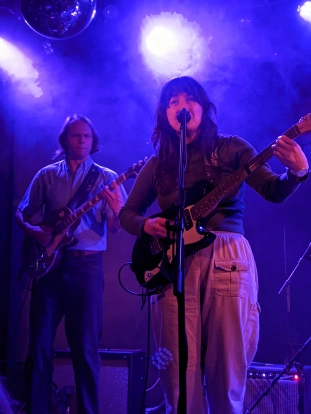
Jonathan Pearce and Elizabeth Stokes both gave solid performances on guitar

The set was not without lulls, not least an unnamed and unreleased song which on first listen sounded about as middle of the road as the Beths get. I remain unconvinced by the very risky and somewhat clumsy chorus on recent single A Real Thing and forgettable Dying to Believe was a disappointing closing number. It was the penultimate song, River Run: Lvl 1, that instead brought the emotional pinnacle of the night. Initially reflective and later propulsive, the song shifted between shades of Stokes’ raw emotions gracefully, with the sweet release of the chorus (“a river will run”) a surefire trigger for waterworks of a different kind amongst many of the fans around me. An awe-inspiring bridge was the one moment of the night where the four Kiwis managed to produce a piece of art that felt greater than themselves, and easily good enough to transcend the four walls of the Brudenell. For a few moments, I could well and truly lose myself in the flow of the music and, tellingly for the crowd around me, the reaction was calmed appreciation as opposed to manic moshing.

The Beths may be two full-length albums deep into their career, but there was a sense on the night that – to their credit or otherwise – bigger things are still to come for the Beths. The quality of the music is hugely promising, and a bigger, bolder performance from Stokes and her bandmates could easily turn the Beths’ live set into a force to be reckoned with. It may be years until they take another long haul flight or two back to the UK, but I feel certain they’ll be heading for grander venues armed with more remarkable sets. Let world domination ensue.

Sons of Kemet live at Gorilla review – a tour de force of British jazz

On a damp Tuesday night in Manchester, Gorilla felt less like a venue and more like a pressure cooker. The room was full an hour before the band took the stage. Not with people waiting politely. With people who knew what was coming.

Sons of Kemet are not a band you ease into. Two drummers, a tuba, and Shabaka Hutchings on saxophones and clarinet. No guitar. No piano. No bass. The rhythm section is the entire engine. And at Gorilla, that engine ran hot for 90 minutes straight.

What makes Sons of Kemet different from every other jazz band touring right now

Most jazz quartets follow a predictable architecture. Saxophone takes the melody. Piano or guitar comps behind it. Bass walks the changes. Drums keeps time. Sons of Kemet threw that blueprint out and burned it.

The lineup is the story. Two drummers — Eddie Hick and Tom Skinner — sit opposite each other, playing interlocking patterns that feel more like a West African drum choir than a jazz rhythm section. They don’t trade solos. They build polyrhythms that stack on top of each other until the room vibrates.

Theon Cross plays tuba. Not as a bass substitute. He plays melodic lines, walking bass, and percussive pops all at once. On stage, he’s the quiet anchor. His tuba lines lock the two drummers together while Hutchings floats over the top.

Hutchings himself is the wildcard. He switches between tenor sax, soprano sax, and bass clarinet mid-set. His playing is not polite. He overblows, growls, and uses circular breathing to hold notes that seem to last forever.

This is not background music. You cannot talk over it. The band demands your full attention, and at Gorilla, they got it.

The absence of harmony instruments

No piano or guitar means no chords. The entire harmonic structure comes from Cross’s tuba and Hutchings’s saxophone. That forces the music into a different space. Melodies are simpler. Rhythms are everything. It’s closer to Fela Kuti’s Afrobeat or the Art Ensemble of Chicago than anything from the Blue Note catalog.

If you’re new to this sound, start with Your Queen Is a Reptile (2018). That album captures the live energy better than their earlier records. But even that record doesn’t prepare you for the physical force of two drummers playing at full volume in a room that holds 500 people.

The setlist: what they played and why it matters

The band played material from all four studio albums, but the set leaned heavily on Your Queen Is a Reptile and Black to the Future (2026).

\

Song Album Live highlight
Hustle Your Queen Is a Reptile Cross’s tuba solo. 2 minutes of pure low-end power.
My Queen Is Ada Eastman Your Queen Is a Reptile Hutchings played bass clarinet. The crowd sang the riff back.
Pick Up Your Burning Cross Black to the Future Fastest tempo of the night. Drummers were visibly sweating.
Think of Home Black to the Future Slower, more meditative. Hutchings played soprano sax.
In the Castle of My Skin Black to the Future 13-minute extended version. The band left the stage one by one, leaving Hick alone on drums for the final 3 minutes.

Every song was extended. The shortest piece ran 8 minutes. The longest pushed past 15. That’s not self-indulgence. The band needs that time to build the rhythmic layers. A 4-minute version of a Sons of Kemet song would be like serving a steak still raw.

How the sound at Gorilla shaped the show

Gorilla is a converted railway warehouse under the Mancunian Way. The ceiling is high. The walls are brick. The floor is flat. That combination creates a specific acoustic challenge: low frequencies can turn to mud, and drums can ring out longer than they should.

The sound engineer made smart choices. The tuba was DI’d through the PA rather than miked from the bell. That gave Cross’s low end clarity without boom. The kick drums were gated tightly to avoid bleed into the toms. Hutchings’s sax was the only instrument with reverb, and it was set dry — just enough to give space without washing out the rhythm section.

Standing at the front, near the left speaker stack, the kick drums hit your chest. Standing at the back, near the bar, the mix was more balanced but quieter. The sweet spot was center, about 10 rows back. That’s where the two drummers’ patterns locked into a single pulse.

Gorilla’s capacity is 550. The show was sold out. The crowd was mixed — older jazz heads in their 50s, students from the Royal Northern College of Music, and younger fans drawn by Hutchings’s work with The Comet Is Coming. Nobody stood still.

What the critics get wrong about Sons of Kemet

You’ll read reviews that call them “political jazz” or “protest music.” That’s lazy shorthand. Yes, Black to the Future has explicit political content — the title track references police violence and colonial history. But reducing the band to a message misses the point.

The politics is in the sound, not just the lyrics. Two Black British drummers playing Caribbean rhythms through a jazz framework. A Black British tuba player using an instrument historically associated with European marching bands to play funk lines. A saxophonist who studied in Barbados and brings that Caribbean phrasing into every solo. The music itself is the statement.

Another common criticism: the songs are too long. I’ve read reviews calling the extended jams “self-indulgent.” That’s a misunderstanding of how the band works. The length is structural. You need time to build the polyrhythms. You need time for the tuba and sax to find the melody within the rhythm. A 7-minute version of “In the Castle of My Skin” wouldn’t work. The song is the journey.

If you want tight 4-minute songs with verse-chorus structure, do not go to a Sons of Kemet show. You will be bored. Go see a pop band. This is music that asks you to sit with discomfort and repetition until the release comes.

How to get the most out of a Sons of Kemet live show

I’ve seen them four times now — once at a festival, twice at smaller venues, and this night at Gorilla. Here’s what I’ve learned.

  • Arrive early. The opening act matters. At Gorilla, the support was Manchester-based trumpeter Matthew Halsall. His quartet played a 30-minute set of modal jazz that set the right mood. Arriving late means missing the context.
  • Stand near the front, but not dead center. The drummers face each other. Standing slightly to one side lets you see the interaction between Hick and Skinner. That visual is half the show.
  • Do not talk during the quiet sections. There are moments when the band drops to near-silence — Cross playing a single note, Hutchings breathing into the horn. The crowd at Gorilla respected those moments. If you’re going to chat, go to the bar.
  • Bring earplugs. The drums are loud. Not “loud for a jazz show.” Loud. I wear Etymotic ER20XS plugs ($20). They cut the high-end harshness without muffling the mids. You’ll hear the tuba better with them in.
  • Stay for the encore. At Gorilla, the band came back for one song: a cover of John Coltrane’s “Africa.” It wasn’t on any setlist. It was a gift. If you leave early, you miss the best part.

Alternatives: when you should skip Sons of Kemet and see something else

I love this band. But they are not for everyone. Here’s when you should skip them.

If you want quiet, contemplative jazz — the kind you can read a book to — go see the Brad Mehldau Trio or Bill Frisell. Sons of Kemet is the opposite of that.

If you want traditional bebop or hard bop, you will be confused. This is not Charlie Parker. This is not Art Blakey. The rhythms are Caribbean and West African. The solos are long and repetitive. The tuba is not a joke instrument here — it’s the harmonic foundation.

If you have a low tolerance for volume, sit at the back or skip it entirely. The drummers play hard. The tuba is amplified. The saxophone cuts through everything. It is a loud band.

If you want to hear Shabaka Hutchings in a more accessible setting, see The Comet Is Coming. That band adds keyboards and electronic effects. The songs are shorter. The crowd is younger. It’s still intense, but it’s more danceable and less confrontational.

Final verdict: is a Sons of Kemet live show worth your time and money?

Tickets for the Gorilla show were £28.50 including fees. For 90 minutes of live music from four of the most technically gifted musicians in British jazz, that’s a fair price. You’ll pay more for a bad seat at a stadium show by a legacy act who mimes half the set.

This is not a casual listen. This is music that demands something from you. If you give it your attention, you get back a physical experience that recordings cannot replicate. The polyrhythms hit different when you feel them through the floor. The tuba sounds different when it shakes your ribcage.

If you’re in the UK and they tour again in 2026, buy the ticket. Stand near the front. Leave your phone in your pocket. Let the drums do the work.