RNS/Ólafsson live at the Glasshouse review – quite possibly the best pianist in the world right now

Beethoven’s flamboyant Emperor concerto was an odd choice for this master of pianistic introspection, but Ólafsson nonetheless proved his world class status following a typically daring and dynamic first half from Sousa’s Royal Northern Sinfonia.

It’s a chilly Wednesday night at St. James’ Park, and the music is a heady mix of Hey Jude, a Wembley-themed Que Sera, Sera and a live rendition of Newcastle United’s own gloriously cheesy anthem Going Home. It’s odd to think that amongst the thousands of fans twirling their scarves in the stands one of Europe’s foremost concert pianists, a fresh United scarf draped over his chic turtleneck. What would Víkingur Ólafsson, a man known for his heartfelt and studied renditions of obscure Bach organ works, make of the wilfully dated sax melody and the thumping 80s drum groove?

Almost unbelievably, it turns out the Icelandic piano sensation wasn’t just there out of curiosity. In fact, he’s been a fan since he was a child, boldly going against the consensus of his Reykjavík schoolmates by picking Newcastle over Manchester United. After this 40-minute Beethoven recital in Gateshead, he recounts the wild events of the previous night’s victorious cup tie, provoking chuckles from the audience as he – dressed in a pristine suit and hair neatly gelled in position like a lovable teachers’ pet – struggles to recall the words “howay the lads”. “I originally picked Newcastle because they played exciting football,” he remarks before reeling off several names from Newcastle teams of yore, as if to prove his true allegiance. “But now I realise it’s because they are black and white, like the piano keys.”

It is a bizarre footnote that somewhat explains Ólafsson’s unlikely appearance in Gateshead. The Glasshouse is undoubtedly one of the finest concert halls in the North but, even for them, getting Ólafsson is something of a scheduling coup – the pianist won a Grammy just days ago for his superb recording of Bach’s Goldberg Variations, which is generally considered as one of the finest readings of that legendary suite of music. Next week he has a blockbuster series of recitals with fellow piano god Yuja Wang in the hallowed concert halls of Toronto and New York. Consequently, the atmosphere in a packed Glasshouse is simply electric. The lady next to me can’t help but burst into conversation about Ólafsson, telling me about his “magical” Prom last summer, the majesty of his Bach organ transcriptions and, most giddily, that “he was on Petroc this morning!” If BBC Radio 3’s silken-voiced presenter approved, then it seemed certain we were in for a classic concert.

First, though, we had the first half of the programme to get through. Fortunately, resident conductor Dinis Sousa is not one for adding crowd-pleasing filler to his concerts. He continued his noble work of promoting contemporary classical music with an opening rendition of Ciel d’hiver, the 2013 piece from recently departed composer Kaija Saariaho. The Finn was known for her fascination with light in all its subtleties, and it was the eerie grey of a dusky winter sky that was most clearly evoked here through Charlotte Ashton’s icy opening flute solo. Later, strings slid from note to note unnervingly, and bubbling harp glissandi gave way to alarming rushes of cymbals. The programme notes suggested Ciel d’hiver would be a beautiful experience, but this was more of an orchestral horror film, vividly portrayed by an RNS demonstrating their fine attention to detail, even in avant garde, pulse-free pieces like this one.

It was a fitting warm up for the following piece, Bartók’s masterwork Music for Strings, Percussion and Celesta, which is known for its inclusion during a particularly unsettling sequence in Stanley Kubrick’s The Shining. In Gateshead, this was a reminder of why classical music is best enjoyed live – two groups of strings players sat directly opposite each other, and their battling, overlapping melodies made for a thrilling stereo experience. It culminated in the electrifying Allegro molto duel, each section leaning forwards as they dug their bows into the strings like fencers going in for a lunge. The strings joined forces for a jagged and impressively synchronised pizzicato passage, whilst pianist Benjamin Powell’s agitated exchanges with Fionnuala Ward’s celesta (essentially a piano that strikes steel plates instead of strings) proved that the piano, at its heart, is in fact a percussion instrument. Dinis Sousa’s conducting was uncharacteristically rigid throughout, and rightly so: this is a claustrophobic piece of music – a symphony in a straitjacket, albeit a straitjacket from which it is desperately trying to escape.

The choice of Beethoven’s Emperor piano concerto for Ólafsson’s visit to Tyneside was mysterious. The programme had originally listed Brahms’ second piano concerto as the headline piece (a convenient change for me, since I’d already seen Sunwook Kim‘s businesslike rendition of that one in 2023). One concertgoer I ended up asking about the switch to Beethoven said it was something to do with Ólafsson’s health concerns, but this concerto, a piece oozing with flair and self-confidence typical of late-era Beethoven, hardly seemed like an easy cop-out for the pianist.

Even so, perhaps for Ólafsson Emperor really is a cakewalk. It certainly seemed that way as he delved into the fiendish technical passages that open the concerto, sat back on the stool as if even he was stunned by the acrobatic feats his fingers were pulling off. This sort of musical showmanship is somewhat unchartered territory for Ólafsson, who in 2023 distinguished himself as a Bach specialist when he embarked on playing the Goldberg Variations for 88 concerts in a row in a world tour that took in every continent bar Antarctica. He’s adept at drawing out the hidden inner melodies of Bach’s knotty fugues, as well as tricky task of locating the deep springs of human emotion buried beneath the composer’s cold mathematical genius. Setting him to work at some relatively uncomplicated Beethoven then – one clear refrain per movement, repeated over and over like a pop song – felt a bit like taking a Ferrari to work.

Nonetheless, there was never a sense of superiority about Ólafsson’s impeccable playing, giving the opening movement’s radiant refrain all the vigour it deserved, then sitting back during the breaks and eagerly watching his melodies take flight in the violins around him, clearly delighted by the results. Emperor‘s dominant emotion is simple and persistent joy, although Ólafsson still found room for brief moments of reflection towards the end of the first movement, easing off on tempo momentarily before a delightful final flourish of quicksilver scales.

It was the slow middle movement where Ólafsson seemed most at home. Beethoven’s tranquil theme here is often likened to a hymn, but to me it sounds starkly contemporary, and even pop-y (is there a through line from Beethoven’s steadily rising refrain to the chorus of Becky Hill’s pop hit Remember?). In Gateshead, Ólafsson’s elegant piano melodies were superbly matched by Sousa’s RNS, the strings sounding delectable over the theme’s hushed rise and fall.

The eventual third movement, foreshadowed with subtlety by Ólafsson a few bars earlier, was pure elation. The bombastic refrain looked like terrific fun to play on piano, and Ólafsson did well to ensure even the very loud passages remained light-footed and playful. For a studious-looking pianist whose discography leans towards the austere, this was a reminder that he is still not one to take himself too seriously. A final symphonic prank from Beethoven – the dummy of a quiet ending on piano, followed by a blast of conclusive chords from the orchestra – cued five straight minutes of rapturous applause.

It took the insistence of Ólafsson himself for the applause to finally abate. After his charming chat about Newcastle United, the pianist had one last surprise in store: an encore of Jean-Phillippe Rameau’s The Arts and the Hours, dedicated to the late concert pianist and former RNS director Lars Vogt, who had in fact chosen this specific Steinway grand piano for the Glasshouse. The piece – a devastating tapestry of falling melodies and mellow harmonies – was the sort of music that words could never do justice to. The piece’s title and its dedication to Vogt made it a deeply moving meditation on the mortality of artists and the immortality of their art. This was Ólafsson at his most extraordinary; there can be few people in the world this good at communicating emotion so powerfully. Ólafsson had been a close friend of Vogt, and shared with us a text he received from Vogt just days before his death in 2022. The message was simple, but it haunted me all the way home after this scintillating night of music: “Don’t ever take the music for granted.”
Orla Gartland live at Leeds University Stylus – great songs worthy of bigger occasions

Despite being in desperate need of an extra bandmate or two, Orla Gartland had plenty of strong enough material to give the crowd exactly what they wanted in Leeds. Unlike her friend and peer dodie, however, her live act still has plenty of room to grow in the years to come.

Idouble- and triple-checked that my ticket proudly branded with the words ‘Orla Gartland’ in stretched all caps (a valuable souvenir to keep for years) was safely stowed in my wallet as I walked across the unsettlingly gloomy campus of Leeds University alone at twilight. It had been a difficult drive in and locating the venue wasn’t any easier. I walked into the modern, sterile white of the student union building with some trepidation, half hoping to bump into some old school mates that must have been no further than a mile or two away. Down a flight of steps and round a corner and at last I found the Orla fans slowly meandering around the cafeteria amongst students hunched over chess boards, iMacs and fast food. Only now did the dejà vu I had expected kicked in; I’d partied with this bunch of stylish, brightly-coloured teenagers not so long ago. As a close friend of dodie, Gartland shares much of the same fanbase with the uke-pop superstar, even if her sound has a decidedly more rock ‘n’ roll edge than anything dodie’s ever released. I recognised a handful of familiar faces from dodie’s showstopping Manchester gig, and overheard phrases like “At The Dodie Gig she didn’t start until 9:30!” or “I hope there’s some choreo like The Dodie Gig!” I wore my dodie mask again with the pride of a passionate football supporter, albeit not quite at the right match.

For all their similarities, it must be said that dodie is simply the more famous and more beloved of the two friends. If O2 Apollo was a Championship-level venue for dodie, Gartland’s Stylus had more of a League Two feel, and this time I had no issues in getting close enough to the stage to properly take in all the action. The venue size inevitably meant there was none of the fancy confetti or versatile lighting that made the dodie gig feel so once-in-a-lifetime – this was a straightforward gig where musicians play their music and nothing more. Gartland’s time on the big stages of Britain is most certainly still to come.

The obvious comparisons to dodie can only be taken so far. After a humdrum choice of opener Pretending, Things That I’ve Learned and oh GOD made a nice pairing with their unmistakably-Orla and risky odd time grooves that got the crowd shrugging along, even though dance moves are difficult to coordinate in 5/4. Sara Leigh Shaw was the right drummer for the job, clattering into the chorus on oh GOD with a laser focus. Tucked away slightly on the side of the stage, she looked uncannily similar to Gartland herself with her own mop of ginger hair that bobbed about in time to the stumbling groove behind that “I don’t wanna think about it” earworm. Gartland meanwhile looked ready to take on the world with her chequered green suit and matching neon green eyeshadow, commanding the crowd atop an inch or two of chunky Doc Martens. Rounding out the band was Pete Daynes. One of the standout performers of the dodie tour, his return was well received, with his enthusiastic jaunts wielding his P-bass around the stage earning him chants of “Pete! Pete! Pete!” on two separate occasions.

The problem was a lack of personnel. Often Gartland’s ambitious pop-rock creations demanded more than the three albeit competent musicians could provide. (Intriguingly, support acts Greta Isaac and Clean Cut Kid could have really done with at least two more performers each – probably another manifestation of the supply chain crisis or something.) Poor Pete often had to oblige with synth parts, backing vocals and a drum machine, and a cool yet unnecessary glowing drumstick wasn’t enough to distract from the fact that this man was born to leap around with his bass like the Easter Bunny. Restricting him to the keyboard rack on the gritty, earthy bomb of a pop song Bloodline for example was nothing short of criminal.

Gartland was an engaging and loveable frontwoman, delivering sure-fire crowd pleasers from the recent album like You’re Not Special, Babe and Over Your Head with guts and charisma. Indie rock gem Codependency sounded somehow even better than the studio version, with Shaw digging in on the sections of the chorus where all momentum was previously lost. It’s a testament to Gartland’s skills as a performer that the quieter moments of the set were just as powerful as the aforementioned rock singalongs. Madison was a joy – a perfectly written acoustic ode to Gartland’s therapist with an expertly crafted melody at its heart. Gartland took to the piano for the touching Left Behind, an achingly vulnerable piece that left the crowd desperate to give Gartland one big hug before she embarked on her last few numbers.

Sara Leigh Shaw leaped atop Pete Daynes to celebrate another successful night on tour with Orla Gartland

I Go Crazy soon picked things up, taking the role of Gartland’s almost-funk jam (see dodie’s In the Middle) and properly turning the pit into a dancefloor for the first time in the night. Daynes was sure to make the most of a bubbly bassline, whipping up the crowd whenever he could. Gartland ramped up the usual crowd participation routine as the set drew to a close. Difficult Things was a good opportunity for a two-part audience call and response section, and there was something vaguely profound and moving about a few hundred concert-goers repeatedly chanting “we never talk about difficult things” in unison. In contrast, synthpop foot-tapper Flatline was a chance for the obligatory “crouch for the bridge and jump up for chorus” schtick which, despite being somewhat painful in the knees after hours of standing in one spot, was impossible not to smile at. I didn’t even know the song, but something about bouncing around in sync with these young and happy strangers was life-affirming.

The encore was mostly reserved for fan favourites More Like You and Zombie!, although as far as I was concerned the gig had already reached its pinnacle. I may not have returned to my car with the giddy buzz that the best gigs give me, but it’s nonetheless hard to fault Gartland, who put in a good shift despite requiring some added support in the form of personnel and some more engaging staging and lighting. With that, I can safely stash away my dodie mask for a long while — or at least until Pete Daynes starts doing his own headline tours.

Awaith live at the Cluny review – Welsh indie trio are worth rooting for

The pioneering Welsh-language trio had plenty of quality material from their recent double album to dig into in Newcastle, although the scuzzy guitars and restless basslines were occasionally let down by Hollie Singer’s limited vocal performance.

It’s a gorgeous, starry night in Ouseburn, and from my vantage point high up in the valley the distant yellow lights of the Cluny could easily be sparkling campfire or a stray firefly. I walk down over the old cobblestone bridge that crosses the brook and, not for the first time, I’m awed by the looming giant that is Byker Bridge – a hulking red-brick symbol of the triumph and brutality of Victorian industry, which today conveys a steady flow of double decker busses some 100 feet above the valley floor. These days, of course, Ouseburn is known not as the centre of Newcastle’s heavy industries, but as a remarkable cultural oasis, with the Cluny as its beloved beating heart. This Tuesday night in February features a typically grassroots bill, including local dance-punks Fashion Tips (who deliver a rather incoherent set, despite the appeal of screaming frontwoman Louise Newman looking like a librarian gone wild) and buzzy Welsh-language post punk trio Adwaith.

In fact, these are exciting times for Adwaith and Welsh rock in general. The fact that the Carmarthen band choose to sing exclusively in Welsh is a laudably punk act in itself – any casual student of Eurovision will know English is the language of choice if you want to appeal to the broadest audience possible – but Adwaith clearly value the promotion of their language and culture over profits. They’re not shy about it either – their recent release, timed to coincide with the tenth anniversary of Welsh Language Music Day, is a 23-track, 75-minute behemoth that wilfully disregards the accepted wisdom that a steady stream of singles and EPs is that best way to grow your streaming numbers these days. Alongside Gruff Rhys and Tara Bandito, Adwaith are the brightest lights in a new wave of Welsh music revivalists hoping to meet and possibly surpass the success of the genre’s 90s figureheads Super Furry Animals.

What was so surprising about that double album, Solas, was not just its ambitious length, but how the quality of the songwriting remained so consistently strong throughout its testing runtime. “It cost us a bloody fortune,” bassist Gwenllian Anthony reminds us twice tonight, pointing towards the merch stand where t-shirts printed with the band’s glorious Welsh names (Gwenllian, Heledd and Hollie) appear to be selling well. Tonight’s set is essentially a front-to-back playthrough of Solas (minus of a few of the duller tracks), a choice which gives the set the meticulous sequencing of an album, although also leaves it feeling somewhat risk-free and predictable.

Opener Planed established quickly that the Welsh language was far from the only interesting thing about this band. Bubbly synths mingled with fidgety, vaguely Middle Eastern guitar snippets (inevitably pre-recorded and played as a backing track), whilst Anthony’s muscular bass riff contrasted nicely with Hollie Singer’s deadpan vocals – a juxtaposition that appeals on song after song tonight. Mwy and Gofyn were stompy early highlights, with Anthony wrapping her fingers around two elephantine bass riffs, the minimalist compositions ending up like warped approximations of Afrobeat and reggae respectively.

Whilst Singer’s quiet and restrained approach to vocals offered some nice contrasts to the gritty guitar music that surrounded her (her almost-whispered performance in frugging standout Y Ddawns was deliciously sinister), other songs demanded a bigger stage presence and a vocal commitment Singer never seemed prepared to offer. Coeden Anniben’s bratty punk strop fell flat with Singer standing largely motionless on stage, and it’s no wonder that there was never the faintest whiff of a mosh pit amongst the Cluny patrons (in fact, sometimes it felt like I was the only one dancing). Singer was upstaged when she swapped roles with Anthony for Pelydr-X, who duly wrapped the mic cord around her neck like a feather boa, planted a boot on an on-stage monitor and gave it her all. It was a theatrical performance that elevated an otherwise middling track, but it also highlighted how much better Adwaith could be with a little more charisma and chutzpah.

Sanas, the recent album’s exhilaratingly unhinged prog rock interlude, disappointingly didn’t make the cut for this show, but we did get its follow-up Miliwn. Easily the band’s most tightly written pop-rock composition, it was only at this point that Singer seemed to fully relax, digging into an anthemic chorus over a lively bassline (the fact that “miliwn” is a simple cognate of the English “million” allowed for a rare opportunity for an audience singalong in Newcastle). Heledd Owen was an engine on the drums at the back of the stage, and Singer’s hook is a knockout. One suspects more singles of this quality are only a matter of time for Adwaith, but for now Miliwn stands alone as their finest effort.

The applause at the end of the set lasted just about long enough to justify an encore of the band’s sleeper hit Fel i Fod and the sweetly sentimental Eto, before the trio were unplugging their guitars and hurrying over to man their own merch stand. I obtained a set list from Owen and happily strolled back onto the streets of Ouseburn and back under Byker Bridge. It had been a satisfying if unspectacular midweek fixture – the gigging equivalent to a 1-0 win at home – but I was reassured that I’d supported a worthy up-and-coming band, both with my ticket fee and my lonesome yet committed dancing at the front and centre of the crowd. I may not have understood a word Hollie Singer sang, but strolling back home along dark wooded lanes, I was left certain that Adwaith’s star is in the ascendance.

PUP live at Project House review – propulsive pop punk pandemonium

The Canadian racket-makers specialise in gloomy songs about hopelessness and self-loathing, but this exhilarating blitz of bangers in Leeds brought nothing but joy to an amped up crowd eager to throw their drinks – and each other – in the air.

About three songs into PUP’s Leeds gig hands are already sprouting up from the centre of the crowd between songs. It’s not out of music-induced joy, but requests for the paper cups of water the stewards in front of the stage are already handing out – such is the heart-racing intensity of this band’s mosh-primed punk tracks. By the time a much needed drink comes my way, the next song is already revving into gear, a volley of cymbals setting the people around me in frenzied motion. I end up drinking half of it and spilling the rest over myself and the poor woman next to me in the ensuing carnage. 90 minutes later, it will be hard to spot a concertgoer not drenched in an odorous mix of water, sweat and beer as they stagger out the venue and back into reality.

PUP have no doubt seen scenes such as these many times before. The Toronto quartet are now five excellent albums in to a steadily successful career in the business of laying their hearts on the line over high octane guitar riffs and pounding drums. 2016’s fan favourite The Dream Is Over and more polished follow-up Morbid Stuff were nothing less than classics of the genre, Stefan Babcock’s unremittingly grim lyrics about harsh Canadian winters proving a winning combination with his anthemic and gloriously catchy melodies. Those albums were a creative high water mark that PUP – and most rock bands, in fact – have struggled to regain ever since, although this month’s new release Who Will Look After the Dogs? proved Babcock’s appetite for catchy nihilism isn’t going anywhere soon (the very first lyrics read “Staring into the void now / You’re going down with the ship”.)

In fact, PUP’s numerous songs about depression, hopelessness and loneliness are so intensely bleak you can understand Babcock feeling a little uncomfortable singing them night after night to packed rooms of thrilled fans. “These songs are so depressing, but we play them and you guys look like you’re smiling and having a good time and it feels… good,” Babcock tells us touchingly at one point. Cue Sleep In The Heat, a song about living alone and “blacking out on my carpet” which sparks sheer bedlam. “You wasted away / And nothing I do is gonna save you,” Babcock’s lyrics admit, but the fans are more interested in belting the free-spirited “woah-oh” hook, one hand on their chests and the other in the air as if it were the national anthem.

Such is the remarkable power of music: write a good melody and even words written from the lowest depths of depression can feel paradoxically awe-inspiring, life-affirming and even hopeful. Time and again, PUP pulled off this artistic miracle in front of an anarchic crowd lapping up every last power chord. Totally Fine’s flirtation with suicidal ideation sparked a wave of crowd surfers, crashing over my shoulders every 30 seconds or so. Free At Last had us screaming PUP’s most brilliantly bitter lyric (“Just ‘cause you’re sad again / It doesn’t make you special”) as Nestor Chumak sprinted through a sinuous bass line and Steve Sladkowski delivered one of the night’s many exquisite guitar solos.

The up tempo bangers came quick and fast, and perhaps a more shrewd use of the band’s slower numbers might have resulted in a stronger reception for recent single Get Dumber – for my money one of the band’s most exhilarating singles to date, but during which I found myself pogoing mostly alone. Babcock apologised before playing his pet song at the expense of the fans’ wishes (a cacophonous PUPTHEBAND Inc. Is Filing For Bankruptcy), but really this show offered a generous helping of old fan favourites. Nine year old magnum opus DVP was breathless musically and literally – one person pinned hard against the barriers had to be hurriedly extracted by stewards mid-song. Babcock couldn’t help but smile when a huge mosh circle formed spontaneously at the grand climax of Scorpion Hill; PUP have long graduated from the days of verbally coordinating these things. All Babcock needs to do is give a quick plea for a baseline level of personal safety at the start of the gig, and the rest of the mosh runs like clockwork, limbs flying and bodies rushing towards each other with instinctive glee.

Like all the best gigs, there was a sense that even Babcock and his bandmates felt that this particular gig was a special one. “Leeds has always been kind to us,” he told us gratefully, and there was a glint in his eye as he romped through an apocalyptic-sounding Paranoid, the band given extra heft by two guitarists from support act Illuminati Hotties. Hotties vocalist Sarah Tudzin stayed on stage for a rendition of Reservoir and promptly missed her cue for the first verse. No bother – the crowd were screaming along so loudly the vocals were barely audible anyway.

Metal-leaning Full Blown Meltdown was an oddly non-anthemic choice of song to close on, and PUP admirably refused to go through the usual encore pantomime. I had moshed my way to the front and was shouting the lyrics back at Babcock when he locked eyes with me, jumped off the stage and grabbed my hands, urgently shouting something off-mic. It didn’t take long for me to get the message – I set about hauling him into the air, pulling at his jeans and then lifting up his Converses above the sea of bodies behind me. It turned out to be a textbook piece of surfing from Babcock, moving at pace around the room six feet above the floor in a smooth arc before washing up back on stage just in time for the end of the song.

With that, PUP left the stage and the crowd caught their breath. A woman collected her cardigan now in tatters on the floor beside me. A man stood alone in the centre of the room holding up a single leather shoe, searching in vain for its owner. Friends reunited and hugged tightly before recounting their own tales from the mosh pit. I beelined for the water stand then relocated my own friends to hug and brag to about my moment with Stefan. The whole gig had been an extraordinary mix of violence and tenderness, loathing and loving, depression and euphoria. In each case, it was the latter that stuck with us in the smelly taxi ride home.

Ichiko Aoba live at the Glasshouse review – perfect serenity from the Japanese isles

Ichiko Aoba’s virtuosic guitar playing proved the main draw for a night of deeply beautiful experimental folk pieces from Japan, prefaced by one of the most extraordinary support acts I’ve ever witnessed.

It’s a blowy Friday night on the cusp of spring in Gateshead, and looking down towards the Millenium Bridge from my beloved Glasshouse, spying a dance troupe recording a video in front of the old Baltic flour mills and smartly dressed couples arriving for drinks at the glassy bars across the water. It’s no surprise I’m not the only lone figure wistfully looking out over the city ahead of celebrated Japanese songstress Ichiko Aoba’s performance – Aoba is the ultimate introverts’ artist. She makes gossamer experimental folk decorated with shimmering guitars and dream-like pianos and propelled by breathtaking vocals that flutter and dance with all the grace of a kite in flight. The staging on the Glasshouse’s second, more intimate stage was suitably homely and minimalist – a large silk lampshade, an elegant mahogany chair, an upright piano sitting patiently to one side. It seemed a blissful evening of music was ahead.

But first, a shock. I don’t usually mention support acts on this blog, but Julien Desprez’s performance of his 2020 work Agora was simply too extraordinary to omit. It started innocuously enough, Desprez somewhat awkwardly walking onto stage in silence and meekly introducing himself. An opening section on keyboard, with Desprez singing sombrely in French, was pleasant enough, although the ever-present dentists’ drill-style synthesiser in the background provided an undercurrent of unease. Soon that undercurrent became a raging torrent, Desprez picking up his guitar and launching into Agora’s punishing passages of bowel-rupturing electronics, flashes of intricate slap guitar interspersed throughout an assault of apocalyptic screeches. His feet moved furiously the whole time, rhythmically mashing away at his extensive pedalboard, a technique which the programme rather romantically links to the French-Canadian folk tradition of podorythmie. Only 20 minutes later did Desprez’s wall of sound finally let up. Just sitting through it required perseverance. To Desprez’s great credit, I’ve never experienced art so profoundly awful.

Much of the unease I felt during Desprez’s fearless performance wasn’t just to do with the music, but the fact that I was sat in a room full of fans of a famously quiet and delicate Japanese singer-songwriter. It would be hard to think of a support act more diametrically opposed to Aoba’s style. Predictably, Desprez soon had people clambering out of their seats and for the exits despite the minimal legroom. A woman on the row across from me was in such a hurry to leave she loudly dropped her phone on the floor. Others put their heads in their hands. On one particularly gruesome sonic explosion the man next to me threw his head back, either in awe or disgust. I was half-worried there might be boos at the end of the performance, but instead the Aoba fans politely clapped, then slowly filed out for the interval in a stunned hush.

Remarkably, Desprez had been chosen by Aoba herself. During one break in her set she teased a knowing chuckle from the crowd by struggling to define what sort of art Desprez made. Was it even music? “I really love Julien’s… dancing,” she settled on, before briefly giving her own version of Desprez-style noise-making by pulling at some random strings on her guitar. Desprez’s selection is a testament to Aoba’s unique eclecticism. A first listen to her catchier tunes may recall Phoebe Bridgers or Lizzy McAlpine, but this is by no means your standard-fare indie folk singer. Instead, Aoba pushes the limits of musical serenity with patient, drawn-out pieces and evocative field recordings from her home on the Ryukyu archipelago of southern Japan. Her artistry culminated in 2020’s magnificent Windswept Adan, a concept album that described a mythical, isolated tropical island by way of meditative guitars and rich orchestral instrumentation.

Of course, there’s only so much Aoba can do sat there alone on the Glasshouse stage – and as a result tonight’s rendition of Windswept Adan’s majestic highlight Dawn In the Adan feels sadly diminished in potency – but by and large Aoba’s compositions are strong enough to stand up to the scrutiny of a bare guitar-and-vocals set up. It helps that Aoba is an exceptional guitarist; Sagu Palm’s Song’s layered guitar plucking had Aoba’s right hand moving in a blur, but the resulting music sounded effortless. Murmurs of smooth jazz came and went throughout her set, particularly on opener Kokoro no Sekai, the sort of dignified waltz you might expect to overhear walking along the banks of the Seine on a summer’s evening.

Aoba’s technique was almost as virtuosic on keyboards, too, drifting gracefully across the keys during the atmospheric Coloratura, a song which winningly ends with Aoba evoking a far-flung seashore with soft whooshing sounds into the microphone. Sonar’s sturdier piano chords and lullaby-like melody was so trance-like it seemed to warp time. I could have sat there listening to it happily for hours.

Aoba, largely expressionless under a low fringe of thick black hair, might initially strike an overly serious, contemplative figure, but this performance proved that musical beauty need not be as stuffy and rigid as the formal Dvořák concert happening across the hallway in the Glasshouse’s main venue. In the silences as she switched instruments Aoba took to humming merrily and skipping across the stage like a fairy. When a persistent phone ringtone interrupted a particularly peaceful moment, she simply mimicked the melody on the piano Jacob Collier-style, causing some of the loudest audience cheers of the night. And then there was the adorable encore number Sayonara Penguin, which featured Aoba singing in a squeaky voice from the perspective of her feathered friend. It was gloriously stupid, and I was left wanting more.

Los Bitchos live at Star and Shadow review – scintillating cumbia finds a new home on the Tyne

Sturdy trainers were indispensable for a night of moving and shaking in one of the trendiest little venues in Newcastle. Armed with an arsenal of percussion, it was Los Bitchos’s touching onstage chemistry that turned a good show into a fabulous one.

It’s been a wild week, but something about stepping into the modest crowd inside the Star and Shadow felt like home. I’d been slightly nervous on the bus journey across Newcastle city centre – perhaps a sign that my solo gigging confidence has been lost somewhere in an almost concert-free summer – but seeing the lights and the staging and feeling the atmosphere of anticipation reminded me why I love live music so much, with company or otherwise. It helped that the Star and Shadow turned out to be my sort of venue. Cinema by day, the small complex is proudly independent and volunteer-run, and it felt like it with its artsy handmade signs and exposed overhead ventilation ducts that butted up against a mirrorball hung up by string, giving the place a cobbled together feel, albeit lovingly. No one I had asked since moving to the city three days earlier had even heard of the venue, which was small enough for the merch queue to be almost non-existent and the bar queue an unusually polite single line leading to one side. The typically awkward task of wrangling my way to the front was a cakewalk; in fact I did a little too well, and my spot front and centre with some space around me was a bit more of a challenge to my shyness than I had bargained for. Being the only member of the crowd in a fresh, bright tangerine Los Bitchos t-shirt admittedly didn’t help me blend in.

The Star and Shadow seemed to suit Los Bitchos too, a somewhat underground four-piece from London whose remarkably niche style of guitar-driven ’80s instrumental cumbia (Latin-American dance music with roots in Africa) has gained them some notoriety as the queens of their genre in the Big Smoke. To call Los Bitchos Londoners is to discount the improbable variety the band members offer. Australian former drummer Serra Petale plays lead guitar and acts as frontwoman; Swede Josefine Jonsson, formerly of a garage rock band, takes bass; Uruguayan model Agustina Ruiz plays synthesiser and born-and-bred Londoner Nic Crawshaw both plays drums and is a working physiotherapist in the NHS.

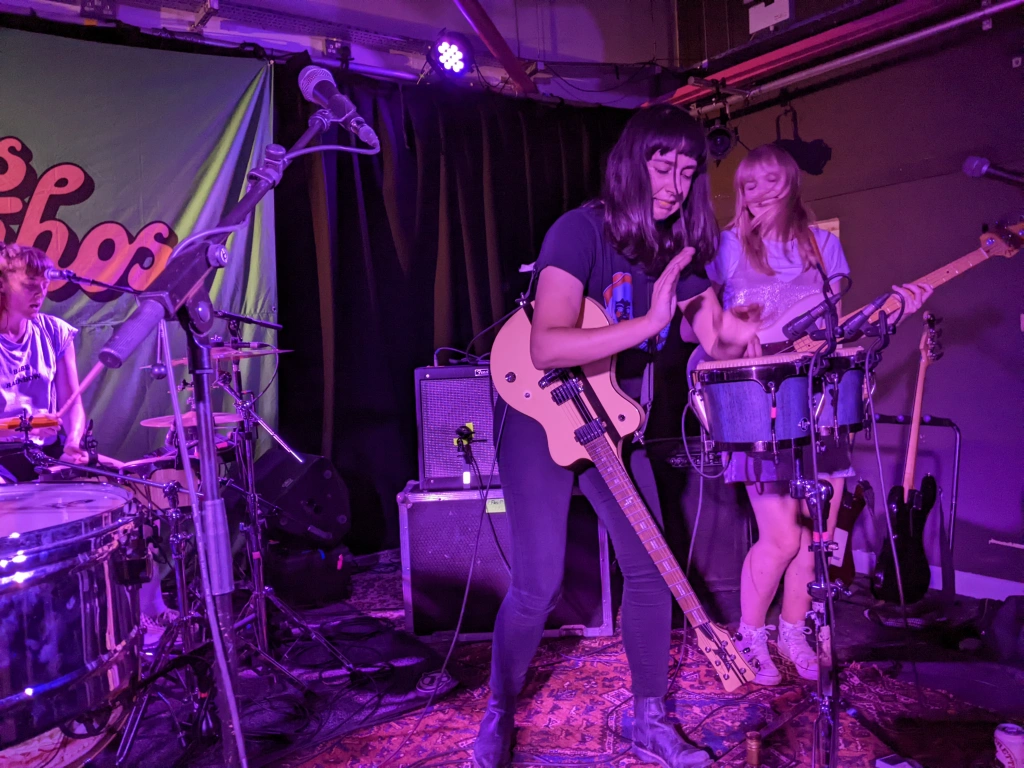
Despite their disparate origins, as soon as the music started Los Bitchos were one inseperable unit, and the undeniable chemistry between performers was a joy to witness. Whether performing coordinated footwork (the band simply having too much fun for it to come across cheesy) or sharing swigs of tequila between songs, the four women were clearly keen to share the spotlight as evenly as possible. Leading the charge was Petale with her slinking, frictionless guitar lines and carefree dancing which was well replicated by an energetic audience. Jonsson was an authority on bass, her riffs heavy and thumping, and Crawshaw was an engine at the back on kit, her kick drum providing an everpresent thwack that got the crowd’s feet moving. Percussion is an essential part of Los Bitchos’s appeal, and every member had a crack on some sort of percussion throughout the night. The several exhilarating drum breaks involved a flurry of clattering cowbell and rippling bongos, a tapestry of sound too detailed to fully appreciate in the moment. In the midst of it all, the four of them looked like they could hardly be having more fun. Even Ruiz, tasked largely with holding down long notes on a relatively quiet synthesiser between sorties on an egg shaker, rarely stood still amid the frenzy.

I had quietly hoped that a live show would give Los Bitchos – and Petale in particular – time to explore their tracks with some improvisation, but instead songs largely stuck to their original blueprint, with Petale’s guitar playing never beyond the remit of your average intermediate guitar player. Instead, the smartly crafted ostinatos were performed with purpose and passion by Petale, who often seemed utterly lost in the groove. At her best, like on impulsive plodder Pista (Fresh Start) or hopelessly earwormy The Link Is About to Die, Petale’s hooks felt inevitable, and quite capable of being played over and over for many minutes without losing any of their appeal. Throbbing Tripping at a Party, which at times sounded like a quaint cumbian Benny Hill Theme, was another example of Petale at the top of her game both in terms of songwriting and performance.

Drum breaks were amongst the show’s highlights

Wisely given the billing it deserved, Las Panteras was an ecstatic, roof-demolishing set closer. A final build – faster, louder and even more thrilling than the original – had the crowd in raptures. The end result was a room of invariably hot and sweaty revellers begging for more; poor Star and Shadow lacked the air ventilation to deal with such an invigorating dance number. Tequila, fulfilling the wishes of several crowd members, was the fated encore follow up. Changing the formula for possibly the only Latin-American surf rock standard in Western popular culture was a necessity, and Los Bitchos’s Tequila was refreshingly intense, Ruiz belting out Spanish into the mic with the force of a pop punk star behind a wall of rock guitars. An uninhibited yelp of “Tequila!” from everyone in the room marked a fitting end to a deeply lovely night of joyful music from musicians that didn’t take themselves or their art too seriously. Such an act isn’t always easy to find.

I walked back onto the quiet evening streets of Shieldfield glowing with that addictive post-gig high, not before taking an opportunity to thank Ruiz and Crawshaw who were already calming down with cigarettes on the entrance steps. A Los Bitchos gig had been a strange way to come to terms with the big week of change in a new city, but it had worked wonders. I couldn’t have wished for a more delightful inauguration.


Katy J Pearson live at Leeds Irish Centre review – illness-battling songstress lifts the spirits

Battling on despite illness, the singer-songwriter’s voice still had just enough oomph to do her finest soft rock numbers justice, and her effortless stage presence brought joy to this rainy Wednesday night in Leeds.

The alarm bells were ringing as early as song one. Bristol singer-songwriter Katy J Pearson opened this evening’s concert in the endearingly ragged confines of Leeds Irish Centre – which looks like it hasn’t changed a bit since it opened in 1970 – with her wistful recent single Those Goodbyes, a treasure trove of gorgeous, meandering melodies and pained reflections on loss. But under the venue’s tinsel-strewn ceiling, something seemed off. Her vocals on the chorus quivered, and she stepped away from the mic in the instrumental sections as if hoping to escape the obligation of having to sing. It didn’t look like she wanted to be there.

She cleared things up immediately after the end of the song. “I’ve picked up a sinus infection, so sorry if I sound a bit shit tonight,” she explained, before joking with guitarist Benjamin Spike Saunders about handing over the cold to him. Pearson apologised to the front row before Saunders chipped in with “The cold is free merch!” It’s indicative of a night that was hampered by Pearson’s illness but uplifting nonetheless, in no small part thanks to Pearson and Saunders’ gift for convivial inter-song patter.

Pearson’s beleaguered vocals are a particular shame because, as an artist, her voice is her greatest weapon. It is a remarkable thing, piercing yet mellifluous, with a delicate sheen that only gets more beautiful the higher into her range she ventures. It’s been likened to a cross between Kate Bush and Dolly Parton, but her music also evokes the trending country star CMAT, albeit with a slightly more sober presentation.

Vocals aside, Pearson also has a gift for beautiful, deceptively simple soft rock ballads, showcased best in her indie classic debut LP Return. Her third album, this year’s Someday, Now, was arguably her first creative misfire. Billed as the first album in which she’s truly taken the helm of the songwriting process, denying her label’s calls for a straightforward pop hit, Someday, Now surprisingly lacked sonic boldness, with a glut of pastel-hued, woozy tracks and a chronic lack of hooks. The fresh material understandably took precedence in Leeds, but tracks like the lethargic It’s Mine Now or the vaporous Constant had a tendency to set the mind wandering.

Luckily, there were plenty of songs from Pearson’s first two albums to keep the crowd moving. The expansive opening of Talk Over Town felt like throwing open the window after the stuffy, staid songs that preceded it, and Pearson’s sole hit Beautiful Soul came with an appealing undercurrent of menace, even though the edits to the chorus melody – apparently a measure to protect Pearson’s voice – detracted from the beauty.

Pearson’s backing band gave an impeccably professional performance, and Saunders’ tasteful guitar solo on It’s Mine Now might have rescued the track had it not been mixed so frustratingly quiet. There were plenty of interesting basslines for Tom Damage to wrap his fingers around, not least in Save Me, noodling his way into a delightful breakdown and finale. Drummer Robbie Kessell, meanwhile, was best described by Pearson herself as “a safe pair of hands,” which is to say Katy J Pearson songs are not known for their challenging drum parts.

In fairness, Pearson’s voice did steadily improve (“adrenaline is a wonderful thing,” she explained), and she was almost at full power for the Fleetwood Mac swagger of Long Range Driver, the new album’s most arresting track. It was a relief, too, that she was more than capable of tackling Return‘s title track alone on stage whilst playing acoustic guitar. An understated ballad about the joys (and sorrows) of personal growth, Return is Pearson’s songwriting magnum opus. In an Irish Centre stunned into silence, Pearson’s elegant melodies proved that, illness or not, she is an extraordinary talent.

It was a testament to Pearson’s Adele-like powers of putting the audience at ease that she could transition from the quiet heartbreak of Return to light-hearted chat with audience hecklers, asking the lighting engineer to turn down the stage lights that were blinding a patch of the crowd. “I hope this gig was acceptable,” she said at the gig’s close, before launching into a story about the last time she played in Leeds and the subsequent “paralytic” night out. Tonight was far from Pearson’s best outing, but it will take more than a sinus infection to dampen this beautiful soul.

Confidence Man live at NX review – ludicrous dance-pop tears the roof off

Fresh from releasing their third – and finest – album, there’s simply no room left for duds in Confidence Man’s supremely silly live show. Even by Newcastle’s high standards, Saturday nights out don’t get much more ecstatic than this.

The first thing you should know about Confidence Man is that the band’s two singers go by the names Sugar Bones and Janet Planet. The other two band members perform exclusively behind what can only be described as wide-brimmed midge-proof hats. Together they make willfully silly dance-pop, and their notorious live show involves camp, somewhat stilted dancing, all duly served to the crowd with unflinching poker faces. If aliens learnt about dance music only through a Wikipedia page and decided to invade Earth in the guise of an Australian four-piece electropop band, they would sound and look an awful lot like Confidence Man.

If Con Man’s aim really is gradual world domination, their plan is working. October’s 3 AM (LA LA LA) was their third LP and quite possibly their best, a full-throttle clubby blast featuring a bounty of nostalgic musical references to Britain’s famous 90s rave scene, plus enough of a resemblance to Charli xcx to get the youngsters like me excited. It is 47 minutes of gloriously uncomplicated party music best enjoyed with your hands in the air and feet off the ground.

It made sense, then, that 3AM only sounded more glorious when flowing out of NX’s meaty soundsystem and into a packed room of dancing fans. Amidst the blasting dance beats, Planet and Bones’ kitsch choreo was occasionally impressive (a few of Janet’s somersaults would score well on Strictly) but always hilarious, delivered with a faux-seriousness that made it clear that we were watching a performance, and by no means the musicians’ authentic selves. In today’s post-Brat world, where popstars are obliged to lay out their deepest and darkest emotions on a record, there was something refreshing about seeing an act plainly giving the fans what they want: 90 tears-free minutes of quality entertainment.

And what entertainment. Breakout hit Now U Do was hastily disposed of at the very start of the set, but justifiably so – Con Man’s new stuff makes this mellow house track sound almost soporific. Recent single I Can’t Lose You, for example, is pure electro-pop gold – a sticky, agitated synth line set to a stellar vocal hook. The band have been churning out winning earworms for years now, but this is surely the most ruthlessly catchy ditty Sugar and Janet have ever penned. Control similarly provoked delirium in NX with its heady swirl of techno bass, backed by suitably batty visuals on the giant screen behind the band – think pigeons with laser eyes and badgers smoking cigarettes.

Not once did Bones and Planet falter in their complete commitment to the bit, launching from one side of the stage to the other as they recounted dancefloor love affairs and wild drug-fuelled nights out, occasionally pausing to execute an acrobatic lift. Album highlight Real Move Touch was served with a particularly involving dance routine, fitting for this breathless sugar rush of a dance track. In Newcastle, Janet’s pivotal yelp of “Don’t you know you make me want to scream?!” sounded utterly electrifying, the perfect distillation of the dopamine-filled mania this concert tended to induce.

Even 3AM’s more questionable tracks were given shrewd facelifts on the night. The patience-testing ode to psychedelics Breakbeat was rescued by a spot of crowd participation, whilst Sugar Bones’ sludgy solo number Sicko came with the theatre of seeing Janet smash a sugar glass bottle over his head (karma perhaps for Sugar Bones uncorking a full bottle of champagne on the front rows – myself included – in a particularly giddy moment a few songs earlier).

It must be said that, if it wasn’t already obvious, lyrically Janet Planet is no Shakespeare. Intoxicatingly heavy frugger All My People reads “With a face like that there’s no conversation / With an ass like that there’s no hesitation” (no prizes for guessing the choreography keynotes here), and pathetic boyfriends account for much of the lyrical inspiration. A Con Man gig is not the place for mulling over nuanced metaphors, nor should it be. Janet and Sugar instead focus their efforts on roof-raising beats and titillating visuals, two things they do extremely well. The exception was So What, which hides its musings on the pointlessness of taking life too seriously behind a curtain of trashy Eurodance synths. Whether they were listening to the words or not, the crowd – encouraged to give each other piggy backs – greeted the track like it was a legendary Eurovision winner.

Reggie Goodchild and Clarence McGuffie (or so they call themselves) were unsung heroes, cooking up club beats behind their veils at the back of the stage and more than proving their worth in two extended instrumental breaks that succeeded in keeping the crowd’s hands happily bouncing in the air even without the two frontpeople for encouragement. Sugar and Janet eventually returned to stage wearing little more than light-up underwear and took back control with a terrific rendition of Boyfriend (Repeat), perhaps the biggest fan favourite in a night of fan favourites.

Effervescent hit Holiday wrapped up the show before an encore of 3AM’s title track, home to the band’s most artfully melodic hook. A shirtless Bones flexed his biceps one last time, Planet (now in a frilly maid’s costume) delivered a final pout, and the crowd erupted. It had been a Saturday night out for the ages. Releasing her pose and taking a final moment to appreciate the crowd, Janet finally dropped her stern persona and cracked a smile. Who could blame her? Everything about this night was pure euphoria from start to finish.

Courting live at the Cluny review – indie’s next big thing has room for improvement

The Liverpudlian post punkers’ live offering is rough around the edges and their fixation with heavy-handed autotune grates – but they do possess the sort of roof-demolishing closing number most bands can only dream of.

The Liverpudlian post punkers’ live offering is rough around the edges and their fixation with heavy-handed autotune grates – but they do possess the sort of roof-demolishing closing number most bands can only dream of.

“Everyone sing the chorus!” Sean Murphy-O’Neill ventures spontaneously in the closing stages of his band’s visit to Newcastle, eyes glinting with a boyish cockiness that rather overestimates the passion for Courting in this small crowd of mostly inebriated university students who will jump up and down to anything resembling a drum beat. Most seem to be here for the more daring shout-along choruses of the band’s debut album Guitar Music, a record filled with ample angry rap-singing and meaty bass riffs perfectly tailored to the tastes of a mostly young male demographic up and down the country. Courting aren’t quite leaders of the post punk pack (that would be Leeds’ red hot Yard Act, followed by Do Nothing and Squid) and their latest album aims for a broader indie rock appeal, but there’s still plenty of bangers to be written in this thriving subgenre. That said, Courting has some way to go to reach the mainstream, a fact that Murphy-O’Neill is reminded when no one sings said chorus. Ego visibly bruised, he hastens back to the mic to blurt out the next lyric. He needn’t fear, though – it takes a few more repeats of the refrain for the eager crowd to get the hang of the hook and soon enough Murphy-O’Neill is grinning and pointing his microphone at Fosters-wielding fans like Freddie Mercury.

You can only get such intimate crowd interactions at somewhere like the Cluny, hands down Newcastle’s finest small venue and an ideal underground cocoon to witness fresh bands like Courting navigate the early stages of their development. Discuss indie music with anyone in Newcastle and the Cluny will come up – this is where bands build their core followings before promotion to O2’s midsized venues across the country, which is why the continued loss of such venues to the cost of living crisis is such a tragedy. Luckily the Cluny, like Leeds’ Brudenell Social Club, seems to have enough word-of-mouth hype to keep it sustained for the time being, and the small dancefloor and seating area is packed by the time the five members of Courting are picking their way through the crowd and onto the stage (a wonderfully unceremonious entry you just don’t get at your local O2 Academy).

The ensuing 80 minutes is an odd mix of Courting’s contentious early punk and more recent, pop-facing indie rock tracks. Opener The Wedding is very much the latter, and despite a few earwormy lyrics (“oh, I’ve been a good boy on this track!”) never quite elevates beyond competent yet flavourless rock. The former, epitomised in a stroppy rendition of Tennis, was much better received, although had issues of its own – when there’s no melody for distraction, spoken lyrics like “You’re a night in the Holiday Inn / I’m a breakfast bar with an unusual toasting conveyor belt” just won’t cut it. What’s more, Murphy-O’Neill doesn’t even serve up a juicy Scouse accent. Instead we get the posh southern boy voice popularised by pre-2023 Black Country, New Road and, lacking that band’s immense musicality or lyrical genius, Courting end up sounding like a pale imitation of their Cambridge contemporaries.

Underpinning it all is an irritating penchant for incongruous autotune that is hard to ignore during a listen of Courting’s otherwise rewarding recent album, New Last Name. This is far from the first time Murphy-O’Neill has received this critique – earlier this tour he wrote on X that all complaints just prompt him to boost the autotune even further – but what Courting gain from the manipulated vocals besides some point of distinction from their contemporaries is unclear. They stand to lose plenty; most of the time it just sounds distractingly silly and only occasionally – like on the rousing The Hills – did the emotion in Murphy-O’Neill’s voice survive all that pitch-correction. Sure, robot-ified vocals can sound great on an electronic track, but accompanied by earthy electric guitars and a real drum kit it just sounds wrong.

Crowd work between songs was hit and miss. They introduced sparkly pop number We Look Good Together (Big Words) by asking the crowd to imagine a drunken night out in Tup Tup (after a quick poll established that Tup Tup was indeed to worst club in Newcastle) and managed to get couples to waltz during PDA (“More romantic! More romantic!”), which was just as well because the track was a clear dud that had been getting an unusually cold reception from the Cluny patrons. Less wise was a needless and unfunny attempt at improvising a story (each band member contributing one word at a time), plus the awkward silence when Murphy-O’Neill announced “we’ve only got one more song…”, the frontman not getting the consternation he’d clearly expected.

Other times, that touch of youthful insouciance injected some much needed fun to proceedings. There were brief renditions of Coldplay’s universally loved Yellow and Fun’s We Are Young (a little obvious given the demographic in the room yes, but I still wanted more), plus by far the best surprise of the night in a full cover of Olivia Rodrigo‘s riff-heavy rager Bad Idea, Right?. This rendition stripped away what little melody there was in the original and added nothing in its place, but the raucous crowd couldn’t care less – it was the track I had been waiting for to compel me into the mosh.

Bizarrely, a cover of a girly American popstar’s song would have been the highlight of the night had it not been for Flex, the undisputed jewel of Courting’s discography, which was rightly saved for the end. Murphy-O’Neill had rehearsed parting the crowd Moses-style before the song, presumably so he could get stuck into the mosh pit, but in the end he stayed onstage, perhaps surprised at just how dense and wild the crowd became. That was because Flex is a song perfectly designed for singalong hedonism, overflowing with simple, bulletproof melodies as well us some shrewdly placed quiet passages to let us catch our breaths. In its composition it deserves comparison to the ultimate indie anthem Mr. Brightside – like that Killers song, every note Murphy-O’Neill sings feels inevitable and timeless, even when the core refrain repeats rarely. Tonight’s rendition lacked the endearingly ragged trumpet solo of the studio recording, but the spine-tingling finale about partying the night away nonetheless summoned pandemonium. In the eye of the storm, I turned around to find myself surrounded by smiling faces of people celebrating their joy, their glorious freedom and, most of all, a shared love of really good indie rock song.

Flex left fans leaving on an enormous high not quite representative of the flawed songs and scrappy performances that made up most of the gig. They may still have plenty of room to grow, but there’s no denying that this band’s star is rising. Another of Murphy-O’Neill’s audience polls found that most of those in attendance hadn’t witnessed the band’s last visit to the Cluny a little over a year ago. A few more solid choruses in the vein of New Last Name and a little more (justified) confidence in their frontman and Courting will be all set to graduate the small venue stages. Let’s just hope that by the time they’re headlining O2 City Hall they’ve seen sense on the autotune front.


RNS/Kanneh-Mason live at the Glasshouse review – epic Beethoven pushes RNS to the limits

Starry pianist Isata Kanneh-Mason’s Clara Schumann had crystalline clarity plus a stunning cello solo, but it was Dinis Sousa’s vigorous tackling of Beethoven’s most fabled symphony that had RNS operating at their genuinely world class best.

It’s 7 p.m. on an unseasonably mild February night outside the Glasshouse and a violinist is in a hurry. She dashes past me as I’m wrestling with my bike lock, already creating her own percussive rhythms through the frantic clip clop of high heels and the rattle of her violin case on her back. Her panic is understandable – tonight, of all nights, is not one to show up late for. Inside, the place is packed, with perhaps double the attendance of underrated Sunwook Kim‘s take on Brahms before Christmas. There are even – to my wide-eyed disbelief – a handful of fellow youngsters in attendance, apparently lured in by the youthful appeal of tonight’s 27-year-old pianist. The high turnout isn’t the only reason this concert feels special. The first person to walk out onstage is BBC Radio 3’s Linton Stephens, who opens with “Good evening everyone here in Gateshead, and good evening to everyone listening at home!” to the excited murmur of the audience, some of whom have already spotted the bulky camera taking up a cluster of seats at one side of the auditorium. The tardy violinist, thank goodness, is on stage with the rest of the Royal Northern Sinfonia, listening intently to Stephens’ preamble about the Schumanns whilst cradling her violin as if nothing untoward happened 30 minutes prior.

As Stephens made clear, big things were to come in the evening’s programme, but it started with a curiosity in Robert Schumann’s Zwickau symphony, a rarely performed piece. Schumann himself gave up on it as he was composing it, leaving behind two unpublished movements. The challenge for Dinis Sousa’s RNS was to justify playing such a work, especially since – as Sousa made sure to warn us at the start of the concert – it ends in such a blatantly unfinished way, the second movement’s subdued ellipsis begging for a lively and redemptive third movement. Soon the reasoning became clear: Sousa was simply having enormous fun, setting off rapid-fire melodies in various corners of the orchestra with a flick of a hand like a kid let loose on an air traffic control dashboard. When the symphony took a strikingly bleak turn in the second movement, Sousa went all in, conducting gut-punching fortissimo chords with a violent full-body thrust.

However, as in life, it was the subsequent Clara Schumann piano concerto (fittingly premiered by Clara alongside Zwickau in the 1835 concert where the two first met) that outshone her husband’s work. Quite possibly the greatest female composer of all time, in the 19th century Clara was acceptable as a high profile virtuoso pianist but not in the more firmly male-dominated world of composing. Today, the fact that this Piano Concerto – which she performed in Leipzig aged 16 – received little fanfare in its day is extraordinary. It is a remarkably fearless, ambitious piece overflowing with winning melodies that call for robust execution in some moments and careful nurturing in others. Melodic caretaker this evening is Isata Kanneh-Mason, a big name in British classical, the big names being the second and third in particular; the precocious Kanneh-Mason family have created a small dynasty in recent years, enshrining themselves in the mainstream when Isata’s cellist brother Sheku took a star turn at Prince Harry and Meghan Markle’s wedding in 2018. Isata hasn’t simply got tonight’s gig playing Clara Schumann on a whim, though. Her affinity for the composer runs deep and she has long championed Schumann as a figurehead of criminally underappreciated female composers over the centuries.

Kanneh-Mason’s star continues to rise, so it was a testament to her humility that tonight she turned the focus primarily onto Schumann rather than herself, delivering the virtuosic flourishes with little fanfare and devoting plenty of thought to the elementary passages that some of her circus-act contemporaries might dismiss as pointless fluff between all the flamboyant fast bits. Indeed, it was the second movement, a piece achievable for any intermediate piano student, which shone brightest in this rendition. Referred to by Schumann as a nocturne, the movement evokes Chopin at his airy, moonlit best, complete with a haunting melody played with limpid ease by Kanneh-Mason. She was to be bettered by cellist Eddie Pogossion, however, who contributed his own delectable solo, wringing out a lament from his strings with a pained, yearning vibrato. A clattering finale to the third movement, with Kanneh-Mason powering her way through some fiendish passagework, made for a satisfying finish to a recital that was something of a revelation for me.

I was so immersed by the high-octane finish to the piano concerto that it was a surprise when Stephens appeared on my row a few seats away from me, primed with a big microphone to give the link during the interval. There was plenty to say about what was coming up in the second half. A survey of conductors by BBC Magazine saw Beethoven’s Eroica to be voted the greatest symphony of all time, beating out his instantly recognisable Fifth (duh duh duh duhhhh), which didn’t even make the top ten. Often described as the symphony that sparked the new Romantic era in classic music, Beethoven’s Third is the epitome of a hero’s journey and a musical expression of the democratic surge sweeping across Europe at the time (it originally had a dedication to the revolutionary Napoleon Bonaparte, which Beethoven retracted when Napoleon turned out to have more dictatorial aims).

It should come as no surprise that Eroica is a highly demanding piece to play for every member of the orchestra, but Sousa was characteristically fearless, launching into those thrilling first two chords at a notably faster tempo than the versions I’d previously heard. He passed the almost constant main theme around the ensemble like a burning torch, sometimes letting it flicker to nothing, other times stoking a roaring inferno. It turned out Sousa’s preference was more towards the latter, urging his violins on towards the first movement’s denouement with such a burning intensity one front row violinist ended up with a broken string.

A lowly fourth violinist was obliged to exchange their working violin for the broken one and spent the second movement backstage fitting a new string, but the waltzing Adagio assai sounded no less full-blooded than the first movement, lazily drooping double basses providing a rich base for a tragic melody. The alarming stabs of brass were spectacular, but the most exciting sound was the flutter of Sousa’s coattails, audible from my prime perch just above the orchestra in the breathless moments before one of Beethoven’s numerous symphonic explosions. A sprightly shiver of strings propelled a comic relief solo from Peter Facer on oboe during the Scherzo, and the finale was replete with solos, each as flawless as the last, with Charlotte Ashton’s turn on flute a standout. One of my favourite things about classical music is the unambiguous, utterly unapologetic way they tend to end and Eroica is a particularly thrilling example, with its rocky crescendo that accelerates towards oblivion. Now with his entire ensemble back, Sousa looked like he had had a whale of a time as he took long applauses and directed various instrument sections to stand for their own applause. In keeping with the democratic ideals Beethoven was voicing support for, every single member of RNS had put in an almighty shift, and there was never the question of whether this lofty masterpiece would prove much for an ensemble from little old Newcastle.

A cellist has already emerged from the back of the Glasshouse by the time I’m unlocking my bike outside. He quietly accepts compliments from a few concertgoers before joining the queue for taxis. For him, this was just another day at the office. Seeing him is a reminder of just how easy it is to forget how extraordinary this whole affair is – the magnificent Glasshouse, the buzzing auditorium, my perfect balcony seat (only a fiver for under 30s!), the fact I can cycle home in minutes. All of it makes me feel incredibly lucky to live where I do, but tonight proved one further surprise: on their day, the RNS really can compete with the London and Berlin Philharmonics of this world. I hope to never take such a musical feast for granted.