Sigrid live at O2 City Hall review – uninhibited pop joy

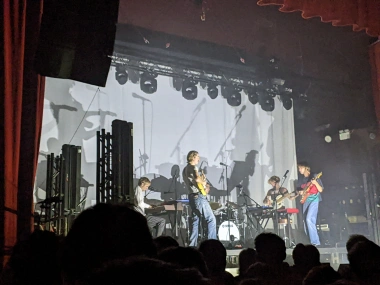
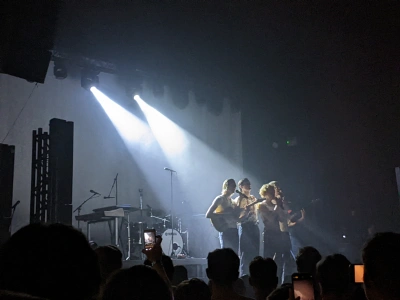
Bursting onto stage with trademark energy and buckets of charisma, when Sigrid found her stride in Newcastle she had the place well and truly bouncing. It was the more tender numbers that needed the most refinement.

Since arriving in the city two months ago, I’ve learnt one thing: Newcastle loves football. Walking through town on a Wednesday evening I soon found myself fighting against a thick swarm of many thousands of black and white shirts, bypassing overflowing pubs and cars plonked onto pavements presumably by fans who concluded the parking wardens must be going to the game too. It seemed a fair assumption, given that everywhere else outside the immediate vicinity of St. James’ Park was so eerily quiet. Even the streets leading up to O2 City Hall that I remembered had been so packed with punters when Declan McKenna was in town had no queue to speak of, and I breezed through the security and tickets checks in a matter of seconds. Inside I found what seemed to be the remaining few Geordies that had managed to pry themselves away from a Newcastle United home fixture for the sake of their chosen popstar. An hour before the evening’s two events took place, that crowd of outliers numbered only a few hundred.

Sigrid may not have been the biggest act in town, but sure enough the O2 City Hall filled up nicely as support act Tommy LeFroy’s set came and went. Like her Norwegian peer AURORA, Sigrid has found a second home over here in the UK, and a string of feel-good hits in recent years has earned her regular appearances in the UK Top 40 and popular repeat appearances at many of Britain’s biggest summer festivals. Where AURORA is an artsy and occasionally experimental Björk descendent, Sigrid deals squarely with no-nonsense, party-ready pop hits. At her best, her exuberant hooks and uplifting lyrical themes of love and self acceptance are easily good enough to overcome any need for added profundity; any critic who listens to sure fire pop bangers Strangers or Mirror and bemoans a lack of lyrical depth needs to go out more.

Sigrid hardly stood still all evening.

A huge part of what makes Sigrid such dynamite at those summer concerts is her radiant stage presence. Never one to stand still, her renowned tirelessness was in full display at Newcastle as she skipped from one side of the stage to the other, hopping on and off monitor speakers and boogieing alongside bandmates with more hip movement than a Strictly final. Her connection to the audience was ever present, often dishing out knowing winks or discreet waves mid-verse to specific concertgoers, invariably triggering an adorable little forest of arms vigorously waving back in the dizzying excitement of being looked in the eyes by Queen Sigrid. The result was a lovely, congenial atmosphere in the City Hall, as if the universally liked friend had gone up in karaoke to sing our favourite tunes along with us.

And, as karaoke singers go, Sigrid turns out to be a pretty great one. She was already belting out an unscripted high note in punchy opener It Gets Dark, her voice piercing and crystal clear, with a well judged hint of grit when the soaring melodies demanded it. Early highlight Mistake Like You also provided an example of Sigrid’s vocals at their genre-leading best, and a dynamic performance from her backing band helped elevate the ballad well beyond its lacklustre studio recording. By far most extraordinary aspect of Sigrid’s performance was how well she managed to keep the standard of vocals so consistently strong in spite of all her onstage athletics. Attempting to sing along to the hits whilst bouncing along in the crowd, I can vouch that breath control like that takes serious skill, and far from all popstars possess it.

It helped too that Sigrid’s band are not your typical karaoke backing track, and clever edits often turned good songs into great ones. A deserved reprise of It Gets Dark‘s deliciously scratchy guitar solo gave guitarist Sondre Berg Abrahamsen – who spent much of the night humbly lurking in the shadows of stage left – a few more glorious seconds to twiddle away till his heart’s content, and the crowd rightly lapped it up. Burning Bridges, the finest example of Sigrid’s punchy, 80s-hinting brand of pop, had an even more surprising edit with a new outro driven by a pummelling techno synth. A track blessed with an anthemic chorus and a sensational strings melody, placing Burning Bridges at track two of the evening set a very high bar that was never quite overcome for the remainder of the show.

Sigrid took to the piano for a selection of acoustic ballads

Her opening numbers may have been a bit too good for her own good, but the momentum was never completely lost. Even the piano ballads at the show’s heart offered a nice change of pace, and Sigrid’s choice to accompany herself on piano, alone under the spotlight, added a degree of drama and earnestness on a night of straightforward pop earworms. Dynamite was poignant but a simplified piano part made it rather unmemorable, and follow up three-chorder Bad Life lacked any of the songwriting or lyrical quality necessary to stand up to the scrutiny of the solo piano treatment. Drab and trite throughout, the song remains easily her most overrated. The inclusion of Bring Me the Horizon’s clichéd pop punk guitars found on the original would at least have added an iota of interest. Unremarkable Dancer followed and lacked an emotional climax for it to stand out amongst the pack of similar pop songs. Sucker Punch was more warmly greeted by fans but – let’s admit it – its verse, with its bumbling, unintentionally comical synth bass and cheap-feeling drum machine, already feels hopelessly dated. Perhaps the song belongs to an era of pop that sounds deeply uncool now but will be in vogue once the early 2010s sound begins to be considered ‘retro’, but, listening in the year 2022, something about Sucker Punch just doesn’t quite work.

Luckily there was still plenty of safer hits in Sigrid’s locker to deploy in a breathless final few tracks. Don’t Feel Like Crying was a quintessential Sigridian self empowerment anthem and surely a direct offspring of Call Me Maybe with its sprightly strings chords. Old faithful Strangers was improved further with some monumental fills from Kasper Waag, who was enjoying his best moments of an outstanding overall performance behind the drum kit. Even relatively unknown encore track Grow was a success, serving as Sigrid’s most affecting love song by far. “Take me anywhere… I’m home,” we sang together softly under the light of our own phone torches, Sigrid’s hips no longer gyrating but instead swaying gently to the reassuring lilt of the acoustic guitar. Basking in the warm glow emanating from behind Sigrid, the only disappointment was that the ballad had to eventually draw to a close.

Unquestionably the song of her career so far, flawless pop smash Mirror was the only choice for the evening’s set closer. “I love who I see looking at me in the mirror” was Sigrid’s simple but effective self love philosophy distilled into the perfect chorus hook, and a wonderfully uplifting mantra to live by. Unfathomably still with plenty of dancing energy left in the tank, Sigird’s passion had those in the stalls jumping up from their seats and bobbing along with the rest of us amidst a dazzling multicolour light show.

Mirror marked a triumphant finish to a somewhat imbalanced performance. Nonetheless, the buzz of deeply satisfied fans in the room after Sigrid had left the stage was heart-warming. Squeezing onto a packed double decker on my journey home was one of the more brutal returns to reality after a gig I’ve experienced. Thickly-woollened men thoughtfully discussed why exactly Miguel Almiron didn’t take that penalty whilst scantily clad young women loudly replayed endless recordings of the Sigrid back catalogue on their phones. So, which was the more fulfilling occasion, an uplifting night dancing the world away to the tune of rejuvenating self affirmation or a 0-0 draw with Crystal Palace? For me, it’s a no-brainer.


Jockstrap live at Belgrave Music Hall review – a delightfully dark fever dream

At their best when basking in strobe lights and stage smoke, Jockstrap proved their credentials in Leeds as artists at the cutting edge of electronic music. No other artist can even begin to sound like them.

Walking into the main concert room of Belgrave Music Hall shortly after doors opened, I was confronted with a disconcerting scene. Smoky and lit a pungent blood red, the room was almost entirely empty save for two lone figures stood beneath the stage and several more sat ominously on seats by the walls around me. Strangest of all, an eerily serene Tchaikovsky string quartet played loudly through the speakers. Such gentle music felt like a poorly disguised lure into some supervillain’s lair, and I took a minute or two to wait on the benches as the crowds built before taking the bait myself and finding a spot at the front.

The background music was an aptly unsettling way to set the tone for the night ahead. Jockstrap’s music may often involve instruments we all know and love – piano, acoustic guitar, strings – but quite how the duo stitch these raw materials together varies wildly, although a meticulous, avant garde approach to electronics usually has a part to play. Underpinning it all is a knack for sinister lyricism and haunting, half-whispered melodies to match the alien concoction of sounds. Talented vocalist Georgia Ellery doubles as violinist in cult chamber rock group Black County, New Road, but the endlessly creative production of Taylor Skye ensures that Jockstrap’s sound is starkly different to her other project: darker, harsher and altogether even less accessible. Ants From Up There turns out to be excellent gateway drug to Jockstrap superfandom.

Ellery occasionally took to violin and acoustic guitar, whilst Skye crafted the beats

They may not sound quite like BC,NR, but the thirst for creative, eyebrow-raising songwriting is the same. On the duo’s slightly more straightforward tracks, this manifested itself in adventurous harmony, like on the shimmering Greatest Hits. Perhaps the closest thing Jockstrap have got to a pop singalong, the catchy “I believe in dreams, do you?” hook had the crowd on the pair’s side early on. There was of course no real drummer for the outstanding percussion break in the bridge, but Ellery was comfortable enough dancing impressively on stage, maintaining the excitement. All night, boredom was an impossibility. Even during these instrumental breaks, Ellery seemed laser focussed on the task at hand, be it decoratively splaying her hands in the air or squatting and clutching the mic stand like a predator in some of the more menacing passages of music. Further away from me, a shadowy Skye cowered over his synthesisers, the humble mastermind behind Jockstrap’s compelling soundworld. The occasions he peeked out his shell for a moment singing lead vocals on the apex of a few songs felt momentous.

Most of the time the genres were harder to define than Greatest Hits‘ retro soul or Acid‘s sumptuous R&B. Debra, for example, sounded like a deeply disturbed Macarena, technical vocal melodies meandering over stuttering, harsh drum grooves. A lyric as heavy and profound as “grief is just love with nowhere to go” was immediately followed by a gleeful “press Y for a party!” and, stood right next to the booming speakers, it felt like I’d dived deep into a dark fever dream where the music made no sense but compelled me to move with the group nonetheless. By the time the utterly bizarre (yet inspired) Bollywood strings entered, it felt like I could have been on another planet entirely.

The remarkable Robert pushed Jockstrap’s craving for musical rulebreaking to its logical extreme. Baleful deadpan spoken vocals (“you’re provoking me, Robert,”) were all the more potent over Skye’s earsplittingly loud synth bass, before a tumult of rapid hip hop, screeching sirens and clanging percussion. “I am very impressed,” Ellery spoke during one gap in the melee with ice cool nonchalance, and witnessing it all, it was hard not to be impressed by the sheer intensity of the performance. It was a nonsensical cacophony, but helped by Ellery’s earnest performance, it was a treat to dive into the chaos.

Ellery’s stage presence was strong throughout

Despite all the full-throttle weirdness, the calmed, reassuring sound of real instruments on the classical music that began the night wasn’t completely inappropriate for an act as sonically varied as Jockstrap. Glasgow, for example, ends with a stunning passage of soaring strings alongside a sorrowful acoustic guitar melody that was loudly belted out by the keen fans behind me, and an opening harp played on keyboard by Skye was just as pretty. Similarly beautiful guitar ballad What’s It All About? was one of the highlights of the duo’s recent debut album and here the luscious strings accompaniment remained charming, as did the inventive harmonic progressions. It was a shame that this time an overbearing bass sound was a detraction rather than a benefit for such a light, serene track. Neon‘s transition from ominous folk to head-banging noise rock was exciting to witness in the flesh, although the big moment was crucially let down by mistimed lights and Ellery’s guitar strap slipping off.

It wasn’t until the transcendent Concrete Over Water near the end of the set that Jockstrap finally struck that perfect balance between chaos and calm. A serene, sparse verse gave way to a strangely affecting, sporadic synth hook that was miraculously controlled by Skye who, head bowed over a synthesiser, resembled a wizard casting a powerful spell. Throw in a stuttering, militaristic snare beat and haunting strings, and the result was one of his most alluring amalgomations of sound to date. Ellery also had plenty to give to the track, namely through a truly remarkable set of lyrics that shone brightest during the stark and vulnerable piano-led middle section, her melodies reaching for the heavens. As the song gathered pace for a final chorus and Ellery took to her violin for a spectacular instrumental, it seemed Jockstrap had discovered the perfect song to cry or dance to. I’m sure many in the audience were doing both.

Intense stage effects were a key element of the performance

And still, the pair had an ace up their sleeves before their brief encore and departure. 50/50, indisputably the biggest banger of their career, began with a brutal pummeling of dance bass and swirling synths, repurposing Belgrave Music Hall into a nightclub from hell. Soon enough we were chanting away to the non-sensical, yelped lyrics (“ah! eh! oo! ee! ah!” was one of the best vocal earworms) before Skye’s choppy drum machine intensified yet again. The mere act of the musician jumping from behind his keyboards and throwing his arms up in the air expectantly was the spark that ignited Belgrave. Soon enough I was engulfed in a viscious mosh pit, our hands reaching up to a furious looking Ellery as she reached back, our fingertips inches apart. Bodies collided and sweat flew as Ellery, doused in stage smoke and flickering in and out of view under kaleidoscopic strobe lights, bent double and screamed the words almost directly into our ears. The catharsis was so strong, any understanding whatsoever of the words we were yelling was unnecessary. My experience of live music had never been so intensely visceral.

50/50 was so all-consuming, returning to the real world outside after follow up I Want Another Affair felt like a shock. It felt like such an experience needed to be somehow mentally processed before I moved on to the task of finding my way home. Fellow fans clutching bright pink signed vinyls on the train platform seemed understandably too stunned to speak. Committing to a song so completely takes its toll, both physically and emotionally. In one sense, Jockstrap’s music had been a challenge to my musical open-mindedness, with its jarring electronics and unpredicatable chord changes (if indeed there are any chords to speak of). However, stood a few feet away from a spellbinding Georgia Ellery, loving their music was easy, a simple act of letting go and allowing whatever feelings that arise – be it rage or peace, joy or pain – to manifest themselves. As the lights dazzled my eyes and the copious mist washed over me, it felt only natural to lean into the beautiful chaos. Lost in it all, I’ve never felt so alive.


Parcels live at O2 Ritz review – reaching for nightclub nirvana

Leaning heavily into the world of nightclub-ready dance music, a constantly evolving Parcels gave plenty of reason to dance the night away for an eager Manchester crowd. As a live act, they’re only getting better and better.

It was brisk autumnal night in November 2018, and I’d just been offered Haribos by the stranger sat next to me in Brudenell Social Club‘s newly established Community Room. Parcels were about to take to the stage backed by shimmering strips of glittery foil, and I was about to take in the spectacle of a proper live pop gig for the very first time. I found myself stood right at Noah Hill’s feet, enjoying the boom of his bass and watching in astonishment as the normal-seeming crowd around me began dancing as if they could hardly control their limbs, with no care as to how silly they looked. In fact, I felt like the silly one standing almost stationary for most of the night, at least until the wait for the band’s big hit, Tieduprightnow, was over. In truth, I had got my generous parents to give me a lift to and from Leeds mostly just so I could hear that one song.

Four formative years later, and I wish I’d paid closer attention to the musical genius that was in front of me. Parcels have only grown since then – O2 Ritz is certainly several leagues above BSC in size; little old Leeds has fallen off a tour itinerary packed with big name European destinations – and my love for the band has grown with them. Their easily digestible falsetto funk-pop has been a companion of mine ever since that first gig, and the release of an ambitious and (mostly) fantastic double album, Day/Night, last year only cemented my infatuation. Nowadays Parcels spend much of their time thrilling audiences with grand tours across Europe where they have a devoted following, particularly in their base of Berlin. A far cry from the fledgling five-piece I saw in Leeds, Parcels are now an incredibly tight-knit group (their second album was recorded with the whole band living together at a Parisian recording studio) and also kings of fashion, having secured a brand deal with Gucci in 2020.

The band’s use of stage lights was interesting throughout the night

Whilst not nearly as glamorous, my situation has changed dramatically too, and I now faced a much longer traverse of northern England to see the five popstars than before. I arrived in Manchester after a late departure – clothes still damp from an earlier downpour and jeans stained from the aftermath of a mismanaged Greggs steak bake – only to find I’d mixed up my Ritzes and Apollos, but an Uber nonetheless managed to transfer me to the correct venue ten minutes before the band took to the stage. My view was of course poor and the usual pint of Coke had to be forgone, but being there for the opening number was what mattered most.

Faces hidden in darkness, the five men took to the stage and gradually pieced together a groove amidst strobe lights, that all-important crowd pleasing kick drum only unleashed after a few minutes of teasing. Eventually Lightenup came into view (a suprising replacement for beguiling album opener LIGHT), and soon the groove settled into one of the band’s most straightforwardly catchy choruses. Sinister Gamesofluck followed seamlessly and was exictingly pumped up to club tempo, although some of the original’s menace was lost in the attempt to get the crowd frugging right from the beginning. It was an opening that would indicate how dynamic the evening’s performance would be; band members often started and ended songs in different locations (occasionally requiring carefully orchestrated intervention from stagehands to move the various keyboards) and Parcels played for long stretches of non-stop music, one song morphing into another with the skill of a talented DJ. Several tracks were redesigned (and some cases miraculously reinvented) for the modern dancefloor. Anatole Serret’s kick drum, settling on a largely unwavering 120 beats ber minute, boomed heavier than ever under every intricate guitar groove, accompanied by Noah Hill’s dexterous basslines which only became more compelling with each repetition (and there were many repetitions).

Lordhenry, the greatest weakness of the band’s latest release, got the biggest facelift from the band’s stylistic change in direction, with a lumpy middle section mostly scrapped, with emphasis instead on the nut tight opening disco groove. An inspired use of spotlights had the band’s shadows stuttering and shifting behind them in time to the music, the silhouettes so crisp I had to take a moment check whether the background wasn’t just a pre-recorded video.

A band grouped together at the front for an a cappella moment

The best songs, of course, required little tinkering and Parcels were wise in mostly leaving them alone. Shimmering Comingback, with its exciting build and one of Serret’s finest drum parts, was an early unchanged crowdpleaser. Tieduprightnow was also rightly let loose early on – these days the band has plenty of valid replacements for the song as set closer – and the essence of the breakout hit was well maintained. Effortlessly light and catchy, the song is still quintessential Parcels, with silky smooth group falsetto finding a perfect match in Hill’s wonderfully agile bassline. Witnessing the opening riff belted out by the sizable crowd around me with such passion was a joy; I’ve not crunched the numbers, but Tieduprightnow may be my most listened-to song of all time. It was a small shame that extraordinary disco hit Famous wasn’t quite so successful in the flesh, partly down to the lack of punchy strings that propel the original recording. That said, Parcels’ commitment to keeping the show 100% live and authentic was admirable.

If Parcels faltered at any point at the Ritz, it was during the quieter numbers. Perhaps I was stood too close to the bar, but sleepy folk-country outlier Once seemed to go largely ignored by the crowd. Jules Crommelin’s directionless, somewhat dreary melody didn’t offer much reason to listen, either, and by the end there was a feeling a precious slot in the setlist had been wasted. Nuanced Theworstthing also didn’t quite translate to the stage despite some lovely solo guitar work from Crommelin, and the song began to feel tired after a minute or two.

The night’s biggest successes tended to involve grooves good enough for the five of them to wallow in for many minutes at a time without any sign of tiring. A perfect example of this was a surprise rendition of Spiller and Sophie Ellis-Bextor’s underappreciated 2000 hit Groovejet, which triggered one of the biggest crowd responses of the night, with hands flailing in the air and lungs roaring out the wonderfully apt lyric “if this ain’t love, why does it feel so good?”. “We’ve played this song in four European cities,” Patrick Hetherington told us mid-song, “and usually no one really sings along”. Cue even louder singing. In truth it was probably all because Groovejet hit number 1 in the UK but not in mainland Europe, but it was nice to have the feeling we were providing something special for the band, at least until they moved onto their next dates in Glasgow and London.

It was one of the band’s earliest singles, however, the provided the most blissful disco groove of the night. Hideout, reworked for 2019’s breathtaking live cut Elude, came to Manchester transformed once more, faster, busier and even more viscerally thrilling to witness. Now dark figures amongst a sea of dazzling strobe lights, Parcels became the masterminds of what every disco act must yearn for – one riff and four chords that simply never get old. With such a strong blueprint, the details of song structure seemed irrelevant, but big build-ups and the euphoric drops at the end of them only cemented a state of dancefloor nirvana. For those few minutes nothing else seemed to matter, and as the intensity peaked with every musician clearly giving their heart and soul to the music, Parcels seemed untouchable. A remarkable percussion break followed, with Serret driving it all with one ludicrous drum fill after another. It capped a breathless ten minutes of five Aussies at the peak of their powers.

Somethinggreater followed and struggled in the shadow of such a great number, although it remains a strong singalong track, and bassist Hill provided a joyous cameo as lead vocalist. Free was a slightly odd choice of closer but is nonetheless a compelling song, its exuberant piano riff only getting punchier with the eventual addition of a backbeat from Serret. The band ended the night at the front of the stage, singing in the glorious dense harmonies that they’ve become known for. The set had been well paced, and opting out of a contrived encore was shrewd.

In truth, by the time Free started up I was far too tired from my earlier adventures to truly drink in the moment. A headache lingered, as did my niggling worries about the long drive home, which turned out to be a mental battle to stay awake. The gig – and the three hour journey to get there – may have taken a greater toll on me than usual, but it had been worth it, and I could still say with confidence that Parcels’ show had been objectively outstanding, and even better than that unforgettable night at the Brudenell four years ago. I can only hope when Parcels return in another four years time I’ll live a little closer to the venue.


Scott Bradlee’s Postmodern Jukebox live at O2 Academy review – good old-fashioned fun

On a night of covers that could have easily flopped, Postmodern Jukebox rightly leaned into the inevitable cheese with ample vintage glamour. In the end it was impossible not to be won over by the sheer joy of the performances, all held together by a top-notch batch of touring musicians.

For me, some gigs feel like once-in-a-lifetime events to be anticipated feverishly. Take Dua Lipa (a popstar in her world-beating prime) or dodie (a debut tour performance, and incidentally a masterpiece) or even North Americans like Jeff Rosenstock or cleopatrick rarely seen on this side of the Atlantic. Other times, I buy a ticket just because I can. It took about five minutes between my friend Thomas mentioning retro jazz tribute band Postmodern Jukebox in conversation and snapping up our own tickets for the Leeds show a few days later. A golden rule I’ve learnt from my endless stream of recent gigs is that seeing professional musicians in the flesh always brings the potential for something special, even when I’m slightly reluctant to make the effort.

It was fitting, then, that there was little of the usual excruciating wait in the venue for the musicians to arrive; Thomas and I had only just snuck our way into the second row by the time the evening’s compère Casey Abrams bounded onto stage just before 19:30. With the band’s mastermind Scott Bradlee mysteriously absent (an unaddressed elephant in the room for the entire night), it was Casey who was assigned as a zany Master of Ceremonies for the evening, billing it enthusiastically as a “journey through time” and “classic jazz spectacle”. Since 2014, Postmodern Jukebox – a broad and largely undefined collective of New York-based musicians – have established themselves as reliable producers of high-quality pop covers invariably repurposed with a retro flair that often favours swing and early vocal jazz music. The musical arrangements are crucially only one part of the PMJ appeal: the band puts almost as much effort into costuming and visual aethetics for their countless YouTube videos, landing themselves a fair few viral sensations in the process. Whilst I’d never quite been sold by the entire concept – is it all just one, eight-year long gimmick? – I came to the O2 Academy with expections of a glamorous feast for the eyes, complete with Charleston choreo, ridiculous hairdos and surplus peacock feathers.

The band moved to the front of the stage at one point during I’m Not The Only One

I wasn’t to be disappointed. In fact, the feathers were out in full force the opening number, Panic! At The Disco’s relatively unknown Roaring 20s. As mildly annoying as the source material may be, it gave a good opportunity to dig into Brendon Urie’s nods to early dancehall jazz, this time with a real clarinet and trombone parping along. A top-hatted Therese Curatolo was undoubtedly the right woman for the job, fully embracing the role of unhinged pantomime villain over the choppy drums and rattling double bass.

The following first act was packed full of impressive performances, with each of the cast of vocalists keen to make an impactful first impression. Towering Robyn Adele Anderson gave an engrossing performance of Oops!… I Did It Again, before Maris had a joyful uptempo blast through Are You Gonna Be My Girl, more than capable of holding her own when the band dropped out for the big a capella moments. On that song it was Tom Abbott who stole the show, however, stepping out from behind his music stand and blasting out a phenomenal, Parker-referencing tenor sax solo just as the backing band reached full pelt. Even his fellow touring musicians looked surprised by how flawless it was.

Maris was a standout performer

Casey Abrams – one of several American Idol finalists in the collective – made his vocal debut of the night for Sam Smith’s I’m Not The Only One, an excellent singalong choice that seemed strangely suited to PMJ’s plonking walking bass and shuffling snare drum. A breakdown section, with drums swapped for a washboard and piano swapped for a melodica, was one of the show’s many silly highlights. Abrams’ boundless, screechy enthusiasm was mostly contained by the soaring melody, although in later performances he was to cross the line into tipsy-uncle-at-wedding-afterparty territory (an overcooked rendition of Africa to close act one was about as wobbly as you’d expect).

Demi Remick was a pocket-sized powerhouse, ever-smiling as she gracefully leaped around each performer, occasionally taking to the wooden board to the right of stage to deliver one barely believeable tap dance solo after another. A fabulous solo medley in the middle of the first act – with music spanning from Glenn Miller to Stevie Wonder to Darude – was her crowning moment. Less successful was Act Two’s Super Mario medley. With Remick dressed in a slightly half-hearted attempt at Mario’s blue and red boiler suit, the joke wore off quickly and, on a night not short on superficial musical gags, this one stood out like a sore thumb.

PMJ wrap things up in Leeds

For the most part, though, I couldn’t help but get swept up in the self-aware silliness of it all. A pepped-up Bad Romance was slick, with Remick skipping away at her most eye-wateringly fast tempo yet, and Maris embraced the opportunity to perfom Paramore’s Still Into You, taking breaks to flirt flamboyantly with the pianist, bassist or a handful of front-row audience members. Wannabe arrived laden with “doo-wops” as the trio of female vocalists delivered their finger-clicks with choreographed sheen. It was Rogelio Douglas Jr. who was the most convincing vocalist of all, however, belting through a showstopping performance of Radioactive and an exhilarating 60s R&B take on U2’s I Still Haven’t Found What I’m Looking For, a cover that wouldn’t sound out of place amongst the grand showpieces of the Hairspray soundtrack. Legendary joke song Stacy’s Mom (a match made in heaven for increasingly giddy Abrams) and Meghan Trainor’s All About That Bass wrapped up the set in proper singalong fashion, with each of the outstanding cast members bouncing about on stage together wearing various ridiculous outfits. It was a suitably chaotic end for a band that seemed perfectly happy simply to perform music for the sake of music. PMJ’s covers were well made but hardly innovative and thought provoking lyrics were out of the question, but something about the sight of Abrams skipping around onstage in a feather-clad suit and ludicrous Lennon-esque sunglasses whilst singing about his affections for Stacy’s mother made my usual music critic scrutiny seem comically irrelevant. These were just good musicians having good old fashioned fun, and the crowd around me – peppered with vintage hairdos and ancient-looking three-piece suits – lapped it up.

Only once, towards the end of the night, were we hit with what felt like a surprise sucker punch of sincerity. Wedged between two glitzy all-singing-and-dancing showstoppers, Douglas Jr.’s take on Use Somebody opened with a refreshingly simple, soulful piano accompaniment. There was instant chills when the band entered for the second verse, Douglas Jr. closing his eyes and leaning back into the warm accompaniment as the song gained momentum. For the first time, I could feel the intensely vulnerable weight of the lyrics as uplifting group backing vocals punctuated Douglas Jr.’s mellifluous baritone. “I’m ready now / For someone like you” he begged over and over again, a seemingly desperate admission of loneliness or devastatingly weak attempt at hope that cut deeper with every repeat. It was almost a disappointment when a teary-eyed Douglas Jr. left the stage to give way to a hollow Spice Girls cover. Even so, for those four minutes alone, I knew the night had been well worth the effort.


Trafalgar Sinfonia live in London review – a night to remember for years to come

On a rainy summers’ night in central London, a competent and faithful reproduction of one of classical music’s most recognised crowd-pleasers hardly pushed the envelope, but that’s besides the point; this was a night destined to be unforgettable due to everything except the music itself.

Iwas only a little annoyed to find the Circle line from Aldgate East station closed after I’d left my hostel on a drizzly evening in July. Three days into my daunting first solo trip to the capital, I was starting to feel naively at ease with the inner mechanisms of the big city. Not to worry, I thought, I’ll just catch a bus, which was just as exciting and novel as the tube with all its double-decker glory. Happy to find a spot at the front of the first floor, I settled in and watched the city flash red, white and green through a frame of raindrop-speccled glass. I was thrilled for my trip’s big finale to take place, kitted out in the most formal outfit I could bother to squeeze into my suitcase a few days earlier: black jeans rather than blue, a lightweight outer shirt unusually buttoned up. Tonight wasn’t just any gig – this was a classical concert in the pretty (yet relatively modest) church at St. Martin in the Fields, which also happened to be the only affordable venue offering concerts for the dates I’d be in town.

For starters, I knew nothing about the night’s performers. The Trafalgar Sinfonia, regular showcasers of Vivaldi at St. Martin, could be replaced with any dozen-strong chamber group from around the country for all I cared. Then there was the repertoire, which centred around a piece so painfully obvious and commercialised over the centuries that only non-committal classical fans like me would feel the urge to see it live when I’m sure there’s much more newer material to explore rather than drilling out the old favourites. For a little while I worried I was the only such fan in town as I ate a pre-concert bag of crisps beside the bronze lions, looking out for any signs of a queue forming at the firmly closed church doors. In the end it turned out there were perhaps 100 or so concertgoers who, like me, haven’t quite listened to enough classical music to dismiss Vivaldi’s great concerto as overplayed or overrated. By 8pm the pews were three-quarters full, although there was hardly a feeling of anticipation in the air. This was, after all, one of several identical ‘Four Seasons By Candlelight’ performances the Sinfonia were churning out over the course of several months.

“Candlelight” was a term used on the tickets and programming with a degree of creative freedom. A few coloured LED lights at the back and some garish fire exit indicators were enough to make the pair of candelabras seem little more than a decorative afterthought. Much more striking was the huge chandelier hung over the centre of the pews like a giant, draping spiders’ web, paired with a similarly netted front window pane which was eyecatching with its warped, spiralling lines, if somewhat bizarre in the context of a 16th century church.

The imitation of birdsong in Spring was remarkable, with each stroke of the bow summoning up a new thrush like a magician produces doves from a hat.

It had gone 8.15pm by the time the troops took their positions in front of us, with first violinist Richard Milone taking a prominent position at the front of the pack. He was to be a confident (perhaps too much so) and capable compère for the evening, kicking off well by pointing out that St. Martin was built in the same year that The Four Seasons were composed, prompting a polite and semi-interested hum of approval from the audience. Milone not only introduced each season with the lines of anonymous poetry that initially inspired Vivaldi, but took the role of frontman during the numerous violin solos, often embracing the opportunity to wonder around the performance area and slightly into the crowd as he played. He invariably played every solo wearing an enormous smug smile and overplayed so much that his dramatic movements became a key component of the performance. His jaunts – bending the knees and leaning forward for the louder and more demanding sections, rocking back onto his heels and throwing his head back during the seemingly blissful quiter passages – bordered interpretive dance and were instantly distracting, although I did come to appreciate and respect his clear adoration for the concerto as the night progressed. What was more clear was just how good a violinist he was. The famous imitation of birdsong in Spring was remarkable, with each stroke of the bow summoning up a new thrush like a magician produces doves from a hat.

Elsewhere, the spectacle of seeing a fairly large group of strings players perform together was a rare treat for me. (A harpsichordist was barely present, begrudgingly plonked at the back of the group and therefore rather quiet and seperate from the action. The night was really all about violins, violas and cellos.) I love the synchronised dance of the bows, how the players dig into the strings for the louder sections or effortlessly allow the strings to sing for the famous melodies that open Spring. The viola passage that imitates a barking dog was helpfully pointed out by Milone ahead of time, and added some much needed humour and narrative for someone like me who can find songs without words difficult to interpret into something meaningful. Of course, that’s not to say that there aren’t long sections of The Four Seasons that are powerful in their immediacy and vivid storytelling. Summer‘s Adagio and Presto are the most striking examples, with the bows furiously quivering and switching direction in the tempest of their own creation. Vivaldi makes the contrast between the sleeping farmer and incoming storm almost patronisingly obvious, but the movement’s big finale was without doubt one of the most captivating moments of the night.

Winter was electrifying… the closest I think baroque has ever got to heavy metal.

With its placement just after the fairly dozy pieces constituting Autumn (one movement’s relevant poem is literally called The Sleeping Drunkard), the furious Winter was nothing short of electrifying and undoubtedly where the great masterpiece reaches its acme. The opening Allegro not only gave Milone a chance to give us his virtuosic best, but had the entire Sinfonia frantically sawing away at their instruments for that famous refrain, which is uniquely catchy and cathartic; it’s the closest I think baroque has ever got to heavy metal. I could sense the accumulating feeling of awe in the room as the events of Winter unfolded, and the dramatic end to the first movement was enough to prompt an immediate and fervent applause from a crowd clearly not well versed in the poor ettiquette of mid-concerto clapping. A few people took a standing ovation at the end, and although I thought Milone and his crew were impressive, I can’t say I joined in with the over-the-top adoration. That said, it was certainly a relief when I finally got off the back-breakingly uncomfortable pews – as the tickets ominously had the need to make me aware ahead of time, “pillow hire is not available”.

Satisfied, if a little creaky, I wondered back out into the music of the big city: sirens mostly, with pauses on occasion to give way to footsteps and raindrops. The front seat of the double-decker was occupied this time, so I sat a few rows back and tried to avoid eye-contact with the passionate anti-vaxxer that had already begun to pester the poor young parents sat in masks beside me. I managed to escape to Tower Hill before the argument escalated and the man spotted that I too had covered my face. With the iconic Winter refrain still ringing in my ears, I bedded down in the relative safety of the hostel feeling proud of myself for having completed the big London challenge that I had set myself. Nothing about the night’s music or its performers had been groundbreaking – even if Milone’s punchable smirk suggested otherwise – but that wasn’t to say the experience itself was a vital and unforgettable one for me personally. Vivaldi’s timeless magnum opus may be fantastic, but as far as I’m concerned the biggest triumph of the night was getting home in one piece.


Jacob Collier live at O2 Apollo review – in a league of his own

Charming, effervescent and incomparably brilliant at every instrument he can get his hands on, Jacob Collier’s performance was a treat to witness in the beautiful surroundings of the Apollo, even if his catalogue of genuinely great original songs remains frustratingly slim.

Pacing through Ardwick Green at high speed on a mild June evening, my phone hardly stopped buzzing. I had not seen any of the three friends I had planned to meet during my long and somewhat stressful journey into Manchester (a certain Mr. Ed Sheeran turned out to be responsible for packing out every car park within a 10 mile radius of the Etihad), but we were minutes from meeting at Apollo, having each travelled from various cities in the north of England. It was a relief to spot frequent gig buddy Emma in the fast-flowing queue and even more of a relief to survive the scrum at the bar and take our place inside the magnificent theatre (still the best venue I’ve set foot in, although my experiences of last time I visited may have coloured my opinion.) The pair of us worked hard to convince one another that our spot towards the back wasn’t a bad one (the Apollo’s sloped floor worked wonders), although friends Fionn and Matt were rightly smug with VIP tickets and a front row spot.

Regardless of our location, we could all feel the excitement in the air. Manchester was stop 47 for British jazz superstar Jacob Collier on a mammoth world tour, calling at everywhere from Bogota to Bangkok, Stockholm to Seoul. Tickets were sold a year in advance, and Collier is yet to get around to arranging an end date for his vast calendar of upcoming shows. For those familiar with his music, the massive scale of the Collier tour should come as no surprise. Since getting his break on Youtube as a teenager posting intricate, harmonically advanced a capella covers of jazz standards, Collier has become known for his musical maximalism, trying a hand at every genre and every instrument under the sun and yet never coming close to sounding out of his depth. Often it seems like Collier just doesn’t know where to stop; a 2019 cover of Moon River (a remarkable career highlight) involved roughly 5,000 different takes of Collier’s voice.

It’s Collier’s unparalleled command of musical harmony, however, that has created an enthusiastic fan base full of fellow musicians evangelising over his boundary-pushing use of microtonal voice leading or application of brainy theoretical concepts such as negative harmony. Emma and I stood agog as the man himself burst onto stage – inexplicably full of energy after performing the same show over and over for several months – before exploding into opener With The Love In My Heart, a headlong dive into Collier’s idiosyncratic world of sonic surprises and unstoppable creativity. As with much of Collier’s music, it threatened to become overwhelming – dancing in polymetre is hard – but Collier’s infectious vivacity and restless stage presence just about held the hot mess of a song together. At one point Collier acquired a tambourine and rushed to the front of the stage, freed by his Broadway-style headset microphone, his hands a blur of tiny cymbals and his ever present beaming smile perhaps even more dazzling.

Thankfully, Collier’s urge to pack evidence of his musical knowledge and ability into every last song is sometimes contained in subtleties. Feel was a sublime, quiet RnB moment, performed with a sort of precise sloppiness, with every rumble of the bass played ever so slightly late to owe the song a remarkably deep, instrinsic sense of groove. On the night Emily Elbert was a great selection as lead vocalist, delving into the gentle vibrato with breathtaking poise. Refreshingly straightforward folk song The Sun Is In Your Eyes was another clear highlight of the night, with Collier restricting himself to a single acoustic guitar. The result, with its intricate instrumental flutters and equally delightful melody and lyrics, was simply beautiful.

The quieter moments helped big, dense numbers like Saviour and In My Bones feel more manageable in their smaller chunks. Saviour in particular was enormous fun, with Collier flexing his piano and keyboard muscles over a meaty jazz fusion groove. A staggering, if a little long-winded, drum battle between Collier and Christian Euman ensued, with Collier eventually calling it a day and lobbing a drumstick at the gong hung high above his head at the back of the stage. He hit it squarely and perfectly in time with the end of the song; of course he did, he’s Jacob Collier.

Evocative folk tune Hideaway, an early hit for Collier and still his strongest melody by far, was unleashed early in the set. A sprawling, squiggly synth solo thrown into the middle was a discombobulating thrill, and the final payoff into a reassuringly familiar verse was immense. Hideaway‘s magnificence and charm unfortunately highlighted the lack of similar compositional magic in the rest of Collier’s discography. The special ingredient of the best musical compositions isn’t dense harmonic knowledge or technical proficiency; there’s beauty in honest simplicity too, and so far Collier has only fully realised this once.

With the concert drawing to a close, Collier took it upon himself to introduce his band between songs. This was of course fair enough, but patience began to wear thin when a heartfelt cascade of compliments for each of his five members was followed by yet more heartfelt compliments for the members of Collier’s extensive touring crew, each of whom were invariably “the best blank on the face of the planet”. The applause for each and every hard-working member of the team (the Spanish assistant manager, the Italian lighting engineer) grew weaker, and at one point a man behind us blurted out “get on with it!”. It was rude, but we could see where he was coming from.

Eventually, and with all momentum lost, somewhat incoherent pop track Sleeping On My Dreams got things back underway to start the big finale. Collier’s form returned for the encore, which finished with a remarkable moment of crowd participation. Emma and I found ourselves performers of a stirring three-part choral piece, with each part moving note by note according to Collier’s onstage gesturing. The musically literate crowd certainly helped Collier pull it off, but the stirring sound of the 4,000-strong crowd nonetheless made for perhaps Collier’s most accomplished performance of the whole night. There was something genuinely moving about the way the three melodies rose and fell in turn, the audience suddenly becoming the act, Collier our genius puppet master. A proud final applause was for ourselves as much as it was for the man on stage.

There was a hectic few minutes in the aftermath of the concert as Emma and I found our way to Fionn and Matt, stumbling across several music friends and friends-of-friends along the way. Collier’s visit to Manchester had given rise to a great gathering of the north’s young jazz musicians, and I was amongst several large groups of young people strolling back to Picadilly, frantically discussing the highlights of the show. This wasn’t just a gig but a social event to be cherished, and it’s hard to think of a musician – even within the UK’s thriving jazz scene – that can excite such a large pool of young jazz fans the same way Jacob Collier does. As Collier may say himself (although he’d be too humble to admit it), there’s no musician on the face of the planet quite like him.


Black Country, New Road live at Brudenell Social Club review – a sublime resurrection

When frontman Isaac Wood left Black Country, New Road just days before the release of what may become one of the best albums of the decade, the survival of the band looked far from guaranteed. The now six-piece chamber rock outfit return just months later for an intimate UK tour with a remarkable set of unreleased music, regrouped, revitalised and ready to take on the world once more.

Of all the places to be in the UK in the early evening of Sunday 22 May 2022, the beer garden of Brudenell Social Club must surely have been one of the most thrilling. The entire city, in fact, was in party mode with the news of Leeds United’s dramatic and successful finish to the season, and as I walked to meet my friend Joe at the train station, cheering boozy blokes and chants of “we are staying up!” outnumbered the usual motorbike revs and ambulance sirens. The atmosphere outside the Brudenell – a universally adored Leeds institution and the beating heart in the student-filled Hyde Park area – was doubly electrifying: Black Country, New Road were in town for one night only.

What made this gig in particular so exciting was the feeling that BC,NR seem capable of much bigger venues. Their debut album For the first time rapidly earned them a passionate core following of on the pulse young post punk and jazz fans, and the acclaim only grew with February’s unbelievable and more radio friendly Ants From Up There, an album venerated by just about every music critic in the land. Take your pick of any national newspaper, the chances are they gave Ants From Up There all five stars, and deservedly so. It was seemingly all going so smoothly for the Cambridge band until days before that album’s release, when frontman Isaac Wood abruptly left the band, citing mental health difficulties. Just as they were reaching their all time high, it looked like it might all come crashing down on BC,NR. Every song that they had built their career on so far was rendered unperformable in the absence their idiosyncratic lead vocalist. Ants From Up There is a devastating listen as it is, but the fact that such a popular masterpiece will never reach the stage added a piercing undercurrent of tragedy. Planned shows – including several gigs in the US plus a visit to Leeds – were suddenly cancelled, Covid-style. Announced last month, this modest UK tour was billed as an intimate warm-up to a summer of festivals across Europe, and an opportunity for the band to regroup and road test an hour long set of completely new music before taking it to the continent and eventually the recording studio. Joe and I may have been disappointed about missing out on hearing material from the albums we both so loved (I’m convinced Basketball Shoes would have been nothing short of life-changing live), but instead the gig at the Brudenell offered an almost as riveting showcase of what might come next for BC,NR.

May Kershaw, on piano, accordion and lead vocals, was a standout performer

The applause from the packed crowd (tickets sold out in a few hours) was long and enthusiastic when the six remaining members of BC,NR took to the stage. When cheers subsided, Lewis Evans opened with some quiet saxophone, soon joined by singing bassist Tyler Hyde (a candidate for new lead vocalist easily predicted by the most well-informed BC,NR superfans). Suddenly, with no warning whatsoever, all six musicians kicked into gear with startling synchronicity, with May Kershaw’s hands bouncing high on the piano and Nina Lim’s violin bow already beginning to fray under the weight of the heavy rock groove. The distant yelps of giddy fans could be heard over the cacophony. It all felt like beautiful confirmation of what we had all hoped; their frontman may have gone, but the unmatched creativity and exhilarating volatility of BC,NR’s music isn’t going anywhere.

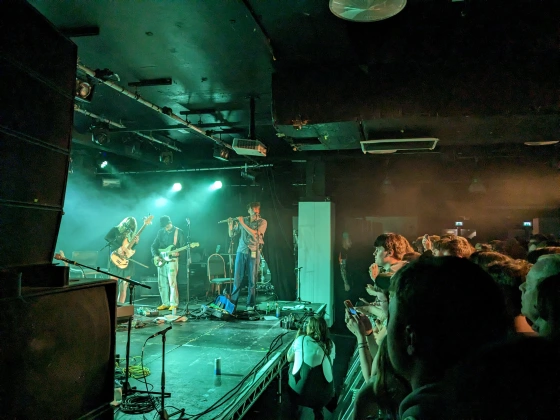
One key silver lining was that, in Wood’s absence, several band members were finally given a voice. Hyde led the way, her passionate and often pained lead vocals one of the night’s many highlights. Underrated pianist Kershaw and her pristine, silky smooth voice was perhaps even better, and a nice change of pace from Wood’s abrasive sprechgasang. She was well appointed for the night’s quieter moments, impressing with an ambitious episodic folk piece early in the set which saw her play both accordion and piano at the same time. The most surprising lead vocalist of the night was Evans who, plonked front and centre of stage, often looked and sounded worryingly diffident, invariably clutching the mic stand beside him for support. It may take time for Evans’ wobbly vocals to shore up, but his songs seemed strong. “In my dream you came running to me / Can’t you fall back into my arms?” was one particularly touching moment, Evans’ introversion highlighting the song’s pained vulnerability. Drums swelled at the end of the track and chaos briefly ensued and as Evans quietly put the mic back on its stand and picked up his flute, the impulse was to hug him and tell him he’s doing great.

Tyler Hyde’s bowed bass guitar gave added menace in the crucial moments

Stylistic suprises were to be expected, and BC,NR didn’t disappoint. Beyond Kershaw’s accordion shanty, there were occasional splashes of classical music, including Tyler conducting her own ensemble of flute, violin and piano at one point. The saxophone/violin combo continues to be an intoxicating one (see the stunningly quiet opening minutes of Basketball Shoes, or the closing passages of Mark’s Theme), and Evans blended beautifully with Lim, who stood in for Georgia Ellery on the night as she embarks on her own UK tour with popular electronic duo Jockstrap. It was a shame that technical issues and incessant screeches from mic feedback tainted these quieter, acoustic moments in the first half of the set.

Pianist May Kershaw is classically-trained, and it’s not difficult to tell. She was the star of the penultimate song, a sublime piece that stood head and shoulders above the evening’s other excellent compositions. The rest of the band sat and listened intently as she played and sang on her own, her delicate, deliberate piano playing a marvel throughout. Later, the other five returned to their instruments to support Kershaw as the song swelled and sighed, before building once more in a final, monumental climax. “I’m only a pig,” Kershaw sang over and over, the final word spat out with increasingly bitter vehemence as the dense orchestration materialised around her. Hyde’s bowed bass guitar underpinned it all brilliantly, generating a mighty, floor-shaking rumble that propelled Kershaw’s subtle little piano ballad to new heights. The long wait to hear a studio verson of this “pigs” song begins now.

A gig like this was never going to be about the songs alone, and BC,NR set out to prove that they could still shine even without Wood. They did so magnificently in a show that revealed new aspects of a band bursting with ideas – to come up with such a strong 60-minutes of material just three months after releasing an album is an astonishing feat. The whole night was summed up best during the opening song, when the rollicking power pop paused for a moment of group vocals. “Look at what we did together / BC,NR, friends forever,” they sang in unison. It was an adorably earnest and perhaps cheesy moment that neatly put into words the unmistakable bond of this talented group of friends. After all the uncertainty of the spring, there’s nothing that can get in the way of BC,NR now. Let the good times roll.


Dua Lipa live at first direct Arena review – a flamboyant new queen of British pop

No expense was spared on the Leeds leg of Dua Lipa’s victorious world tour, after 2020’s Future Nostalgia changed the face of modern pop. With slick transitions and memorable visuals, this was a performance dense with bona fide pop smashes and jaw-droppingly theatrical highlights.

Rocking up in central Leeds in a group of five friends poorly dressed to spend any significant period of time outside on a disappointingly cold Easter Monday, there was a moment on approaching a T-junction in paths that we had no idea exactly in which direction Dua Lipa was gearing up for an arena concert. Already beginning to shiver, we decided we might as well pick a stranger and follow them through a nearby underpass. Soon enough, the stream of punters became a river and then a torrent, with crowds in the 100 metre viscinity of the first direct Arena more akin to what I’d expect ten minutes after a gig, rather than 3 hours before it. It may have only been half past six, but we wasted no time grabbing drinks and finding a spot amongst a crowd buzzing with anticipation.

The truth is, that night it would have been a challenge to find someone walking through that northern corner of Leeds that didn’t have 70-odd quid’s worth of arena ticketing stashed in their wallet. An antithesis to Jeff Rosenstock in every way, Dua Lipa has been vying for chart-topping mainstream appeal for years now, and she’s frequently been granted her wish, garnering millions of fans worldwide. Her latest album, Future Nostalgia, is packed full of the sort of hits that manage to infiltrate the consciousness of virtually everyone in society. Even if you think you don’t know mind-blowingly successful smashes like Don’t Start Now or Levitating, trust me, you do.

What was new with Future Nostalgia was the wave of critical acclaim that came with the endless radio play. The album was bold in its unapologetic support of what I like to call the ’20s disco revival; a stylistic shift towards retro styles in contemporary pop music that is generally deemed to be a result of the dancefloor-yearning brought on by the pandemic. Giant names like The Weeknd, Doja Cat and even Kylie Minogue are all in on it, although whether the new world of modern disco-pop will survive now the society is opening back up again remains to be seen. Nevertheless, Lipa continues to position herself as the movement’s flagbearer, adopting an 80s-inspired public image whilst digging deep into the realm of slap bass lines and superfluous glitterballs.

To that end, me and my friends Emma and Hattie had to crane our heads towards the distant roof of the arena on entering to tot up the evening’s glitterball count: a somewhat underwhelming three (and, once they had been lowered during the performance, they turned out to be more like cheap-looking shiny balloons). The no-doubt immense budget for the Future Nostalgia Tour had clearly been utilised in other aspects of the show, not least a dozen-stong dance troupe that bounced and boogied their way around Lipa all night. Lipa is of course a great dancer in her own right, and the sheer amount of moves and she memorised and pulled off for the performance was impressive. For her, it was mostly a case of ticking off all the things arena-sized pop divas are supposed to do: we got Dua playing with a sparkly cane or Dua throwing poses behind a morphing wall of umbrellas or Dua being carried face-up across the stage in the middle of a verse, singing all the while. She may lack some choreographic originality, but that’s not to say she wasn’t convincing. The astounded crowd around me fumbled for their iPhone cameras whenever Lipa so much as flicked a gloved finger in our direction. On occasions when Lipa responded to the cameras and flashlights with a brief smile, the screams almost drowned out the music.

The umbrellas were out for New Rules

Physical, Lipa’s gleefully self-aware pastiche of Olivia Newton-John’s 1981 hit of the same name, was an excellent choice of opener and a statement of intent, with lines like “baby, keep on dancing like we ain’t got a choice” finding a match with zumba class-ready dance moves. An early onslaught of Future Nostalgia bangers ensued, finding a highlight in Break My Heart, Lipa’s most whole-heartedly disco number. The glitterballs remained dormant, but instead a dense web of tiny spheres descended above Lipa and her dance crew, pulsing with colour in time with the shimmering rhythm guitar and chest-rattling bass line. Then there was the unbelievably funky Pretty Please, plus groovy midtempo hit Cool, during which Lipa was joined by a pair of dancers on rollerskates, each encircling her and beaming from ear to ear. They got one of the loudest applauses of the night when they stole Lipa’s spotlight for a moment to perform a few somersaults and headstands on the well-implemented satellite stage.

If the rollerskaters weren’t Eurovision enough, We’re Good – a dubious inclusion at the best of times – featured a cameo from a giant inflatable lobster for reasons that never quite became clear. It seems that money to spare can occasionally work out as a hindrance rather than a benefit for shows like these. Early hit IDGAF, here demoted to We’re Good‘s introduction as a 30-second snippet, would have been both much more sensible and much more effective, with or without a lobster.

Somewhat trite strings ballad Boys Will Be Boys gave the night some necessary breathing space, although I’ll admit I was relieved when Lipa got seemingly impatient and threw in synths and a thumping electronic kick drum two choruses in. A slew of Lipa’s biggest dance hits followed and, having reserved all my excitement for Lipa’s pop and disco songs, I was pleasantly surprised at just how compelling the segment turned out to be. It helped that Lipa and her troupe had ventured out onto the satellite stage once more, surrounded by the crowd and seemingly caged up thanks to clever lighting and a metal rig that had descended from the ceiling. The claustrophobia suited songs like Electricity and One Kiss, which now sounded perfect for a gloomy, body-filled nightclub. Extended remixes allowed for more dancing, more energy and more outfit changes, with Lipa switching from one glitzy leotard to another just as one global number one hit blended seemlessly with the next global number one hit. I could have danced to that handful of songs long into the night.

A lighting rig descended for an intimate dance music segment

I spent a majority of the night in giddy anticipation of awarding Undertone‘s second ever five-star gig rating, so I was a little disappointed when Lipa eventually started to lose her momentum in the final third of the concert. Future Nostalgia bonus track Fever was a poor set list choice over Blow Your Mind (Mwah), particularly becuase it entailed a pre-recorded feature from Belgian popstar Angèle on the big screen. Elton John was similarly featured on tribute track Cold Heart, but I remained unconvinced by the song’s lack of fresh ideas whilst Lipa and the troupe attempted a tear-jerking end-of-gig group hug.

Electrifying Levitating and Don’t Start Now – surely two of the most monumental (and musically flawless) pop songs of the decade – were rightly saved for the encore, before confetti cannons cued Lipa’s theatrical disappearance into the stage, mid-pout. Lipa aptly took to a platform and floated around the arena for Levitating, leaning against the railings and waving down at the adoring crowd in a third, figure-hugging catsuit. Now unavoidably, we had been reduced to peasants bowing down to our queen of pop as she purveyed her subjects. She had every right to, after all: no popstar in Britain today quite has the global reach or the dense catalogue of hits currently in Lipa’s possession. With all the flabbergasting showbiz glitz and glamour of the Future Nostalgia Tour, she has ensured a firm grip on the crown for many years to come.


AURORA live at O2 Academy review – smiles all round

Norwegian popstar AURORA’s unending love for her audience was uplifting from start to finish on a heart-warming night in Leeds, even if her staging and set list left something to be desired.

“Ican already tell this is going to be one of those shows that makes me face hurt,” giggled lovably humble songstress Aurora Aksnes in front of her Leeds crowd, having bounced her way through the first few songs of the night. She was far from the only one in the room that would need to give themselves a face massage from all the smiling that the night would entail. Instantly, Aurora’s heartfelt connection to the crowd was apparent as she labelled us her “Leeds warriors” and appeared genuinely shocked as she cracked on with opener Heathens, as if she’d half expected to walk out onto stage and see no one at all.

No, the sell-out crowd confirmed, Aurora remains more popular than ever. Even my dad joined me for this one – his first concert in decades – and we were both surprised by the age diversity of the concert goers as we trudged towards the back of a queue that seemed to snake all the way back to the car park. A large part of that audience was likely to have been inspired to buy their tickets largely to see a single song – myself included. The nuanced folktronica of Runaway was a monumental moment in Aurora’s career, gaining sleeper hit status in 2021 when it found the favour of many millions of teens on TikTok, thus launching the Norwegian singer well and truly into the mainstream. The shimmering, nostalgic piece found a good match in last summer’s endless black and white clips of friends dancing in the rain or watching a particularly beautiful sunset, often paired with a caption that recalled pre-Covid days before the bliss of youth had been taken away from us. The promise of Runaway – and the dazzling display of golden light that I imagined would be paired with the soaring choruses – was easily enough to propell me into the Academy in search of goosebumps.

It was frankly a reckless decision, then, for Aurora to place Runaway in the inconspicuous slot of track three for the night. Her recent album was strong, yes, but it would surely take more spectacular material to rightly oust the closing slot that Runaway so deserved. On the other hand, Aurora may just be one of many artists that has quietly grown a distaste for her biggest smash. Indeed, telling the crowd “this one’s for you,” before starting the verse may have hinted that Runaway was only included at all to appease the hit-hungry fans.

Instead, emphasis was placed on post-Runaway tracks, and luckily Aurora has a good selection of material to pull from. The Seed was an early success, gritty and menacing with its pounding bass and Aurora delivering the line “you cannot eat money” in the style of a tribal chant. The message is nothing ground-breaking, but the empassioned performance nonetheless made The Seed‘s message of climate-sceptic greed one of the most impactful moments of the night. Earthy Blood in the Wine carried similar weight earlier in the tracklist, even if the song does flirt dangerously with Spaghetti Western clichés. Warrior was another early fan favourite, with the audience responding to Aurora’s empassioned performance with thousands of fists raised in time with the music.

Aurora’s numerous acoustic ballads were clumped rather clumsily in the middle of the set, resulting in a very significant drop in energy for a long 30 minutes. Blink-and-you’ll-miss-them mid-tempo ballads like Exhale Inhale and A Little Place Called the Moon formed the night’s musical nadir, and even listenable Exist For Love got sucked into the black hole of dullness. When bubbly dancepop number Cure For Me eventually kicked into gear, the overwhelming feeling was of relief that the show seemed to be back on track.

Aurora threw a large shadow on slower songs

It wasn’t just relief that made Cure For Me so electrifying witness – the song is unbelievably catchy, with a slightly silly chorus hook that would be the talk of any Eurovision season (Norway, there’s surely still time to switch…). Aurora relished in the song’s playfulness, flicking her hair from side to side and leaping from one corner of the stage to the other as flashes of bright green and red dazzled from the lights behind her. Momentum was maintained with dancey The Innocent and 80s-tinged hit single A Temporary High, which elicted the strongest reaction from the audience all night.

It must be said that the staging – mostly consisting of a large circle propped up behind Aurora – could have been better. It was at its best when projecting Aurora’s shadow for the night’s calmer moments, highlighting her immaculate armography in the process. Most of the time, however, the circle was an occasionally-flickering variety of solid colours that begged the question why a huge circle was even necessary in the first place. Minimalism is all well and good, but simple props require just as much purpose as the intricate ones. Instead, Aurora’s surroundings felt uncharacterically half-hearted.

Nonetheless, the crowd demanded an encore, although using up brilliant crowd-pleasers like Queendom and Running With the Wolves before scuttling backstage undoubtedly made the chants of “one more song!” more restrained than they could have been. A long preamble made largely-unfamiliar 2016 track Through The Eyes Of A Child inevitably anticlimactic, and there was no special lighting that the performance so desperately needed in order to highlight the beauty of the moment. A simple spotlight on a slowly rotating glitterball would have surely done the trick. Giving In To The Love was a similarly questionable choice to finish the night, but the run-of-the-mill electropop track was sold well with some vigorous hand-waving on Aurora’s part.

The second half of the main set may have had too many good songs to mention, but the true highlights of the night came between songs. For the whole show, the artist seemed infatuated by her audience, inspired by the crowd’s willingness to dance freely and to some extent open their hearts to her in return for her music. “I don’t want to leave!” she giggled during the encore, rambling her way towards her penultimate track with childlike giddiness. Other times she was more of a sage-like mother figure. “Never forget,” she assured us at one point, “you are so much better than the person that hurt you.” It felt almost as if Aurora had sat down with each and every one of us and listened to all our personal problems like a loving friend before offering her kindest, purest words of wisdom. If Aurora’s aim was to leave each concert-goer with a lasting smile and a warm glow inside, she succeeded effortlessly.


The Beths live at Brudenell Social Club review – bubbly, light and a little safe

10,000 miles away from home, the fact that New Zealand indie rock outfit The Beths sold out Leeds’ Brudenell Social Club is remarkable in itself. What’s more, Elizabeth Stokes’ confessional yet light-hearted compositions were warmly received, even if her set lacked ambition.

Iam often amazed when I arrive at gigs to walk into a room packed full of people that all share a love of a single artist or band. When I’m with likeminded friends or at a gig the magnitude of something like Sam Fender in an arena it’s less remarkable, but when I’m stepping out of a cab in Hyde Park and joining a small queue outside the Brudenell for a rock band that has long been a private affection of mine, it’s a very strong feeling indeed. Having travelled from the other side of the world, the Beths were in our corner of Yorkshire for one night only and, ensconsed in the growing hubbub of bona fide fans, it felt like quite the occasion.

My surprise about the crowd should do nothing to belittle a band very much on the rise, not least in their home country, where they were one spot away from landing themselves a number one album with 2020’s solid Jump Rope Gazers. Sunny vocal harmonies help them stand out from the vast number of traditional four-piece rock bands around the world, as does their frontwoman Elizabeth Stokes, whose light, somewhat aloof vocal style is a surprisingly good match for her unfettered and confessional lyricism. Tonight her nonchalance is on full display, punfunctorily announcing her band name and their Aukland origin in the aftermath of screeching opener I’m Not Getting Excited. Even Stokes found it hard to stifle a smile as the crowd cheered and waved; an opening, repeated single guitar note is a well known rock trope, and on this song it was effective as ever in building anticipation for the first entry of the competent and confident performers around Stokes.

Only occasionally did the band regain the giddy heights of their strong opener. Cosy rock ballad Jump Rope Gazers was one highlight and perhaps the best singalong number of the night. Here Stokes’ vulnerable songwriting is shown at its most poignant. “I think I loved you the whole time, how could this happen?” she wailed to us heartbreakingly. The belting Uptown Girl – probably the punkiest two minutes and 43 seconds of the Beths’ discography to date – was an inspired choice of follow-up, with Stokes drowning out her sorrows and flexing her lead guitar muscles with one nut-tight riff after another. Throw in the sweet falsetto harmonies of Jonathan Pearce and Benjamin Sinclair, plus the furious snare fills of Tristan Deck and the result is the Beths at their exhilarating best.

Stokes’ songwriting may have been consistently good, but this routine showing did little to add to what we’d all already experienced on their two studio albums. Four-part vocal harmonies came at the cost of on-stage stasis, with every single performer tethered to the microphone set up in front of them. On such a small stage there’s little else they could have done, but any adaptation of the studio recordings whatsoever was sorely needed to make the gig feel like anything other than four musicians doing their job (albeit very well). Some endearing bandmate banter and compliments towards the Brudenell’s bespoke pastry offerings were about as special this set got.

Nonetheless, a band as rich in solid rock songs as the Beths can get away with not producing an all-round performance. It’s telling that even with the omission gritty debut single Idea/Intent and, tragically, Don’t Go Away (the best song from the band’s latest album), the set was not short on compelling songs. Po-faced guitarist Jonathan Pearce was suitably focused for the superbly squelchy guitar solo on Whatever before giving way to a chant of “baby, you’re breaking my heart!”. It was a hook so catchy and joyful the cliché lyrics only seemed to make the whole thing even more of a joy to experience. Little Death sounded much more impactful live, and the chorus spawned a surprisingly ferocious mosh pit that had me and the tamer fans around me periodically checking over our shoulders for the next time a crazed youth might barge into the back of us.

Jonathan Pearce and Elizabeth Stokes both gave solid performances on guitar

The set was not without lulls, not least an unnamed and unreleased song which on first listen sounded about as middle of the road as the Beths get. I remain unconvinced by the very risky and somewhat clumsy chorus on recent single A Real Thing and forgettable Dying to Believe was a disappointing closing number. It was the penultimate song, River Run: Lvl 1, that instead brought the emotional pinnacle of the night. Initially reflective and later propulsive, the song shifted between shades of Stokes’ raw emotions gracefully, with the sweet release of the chorus (“a river will run”) a surefire trigger for waterworks of a different kind amongst many of the fans around me. An awe-inspiring bridge was the one moment of the night where the four Kiwis managed to produce a piece of art that felt greater than themselves, and easily good enough to transcend the four walls of the Brudenell. For a few moments, I could well and truly lose myself in the flow of the music and, tellingly for the crowd around me, the reaction was calmed appreciation as opposed to manic moshing.

The Beths may be two full-length albums deep into their career, but there was a sense on the night that – to their credit or otherwise – bigger things are still to come for the Beths. The quality of the music is hugely promising, and a bigger, bolder performance from Stokes and her bandmates could easily turn the Beths’ live set into a force to be reckoned with. It may be years until they take another long haul flight or two back to the UK, but I feel certain they’ll be heading for grander venues armed with more remarkable sets. Let world domination ensue.