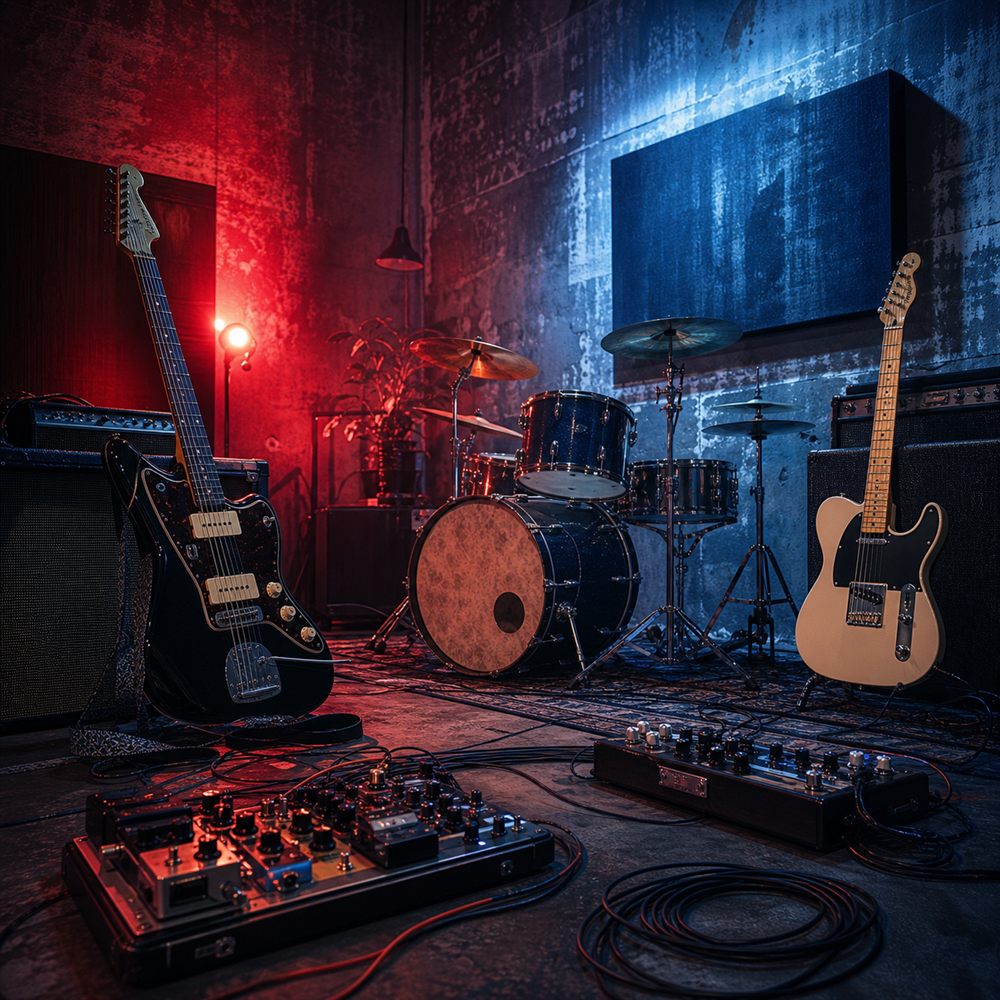
Why Tiny Jazz Clubs Still Shape Big Listening Habits looks at how music and entertainment become more rewarding when you listen for detail instead of just chasing the newest release.
For small jazz rooms, the useful question is not whether something is fashionable this week, but whether it holds attention after the first impression.
The best notes often come from pacing, texture, arrangement, and the way a performance changes a room. Those details help a playlist, album, or scene stay memorable.
Listen for the room as much as the solo.
Notice how the rhythm section reacts when the audience is close.
Choose recordings that keep some live texture instead of polishing everything flat.
Use this as a starting point, then return to the track, record, or score in a different setting. Good music usually gives back more when the second listen is slower.
Five New Indie Tracks Worth Adding to Your July Playlist looks at how music and entertainment become more rewarding when you listen for detail instead of just chasing the newest release.
For indie playlist, the useful question is not whether something is fashionable this week, but whether it holds attention after the first impression.
The best notes often come from pacing, texture, arrangement, and the way a performance changes a room. Those details help a playlist, album, or scene stay memorable.
Start with songs that reveal a clear hook in the first minute.
Keep one slower track in the middle so the list can breathe.
Save the brightest chorus for the final third of the playlist.
Use this as a starting point, then return to the track, record, or score in a different setting. Good music usually gives back more when the second listen is slower.
On her first UK tour since the release of her critically-acclaimed debut album, Nubya Garcia’s complex jazz creations were finally given time and space to be explored in their full glory, aided by a stunning trio of supporting musicians that might have even outshined Garcia herself.
It’s been a while coming, but as my friend Emma and I rocked up at Gorilla on a non-descript weekday night in Manchester, my concert-going muscle memory started to kick in. For obvious reasons, my gigging habit had previously stopped almost as soon as it began. I started by catching Parcels at Brudenell Social Club in 2018 (I was luckier than I realised; 3 years later and they’re one of my favourite bands of all), and managed to fit in American rock duo of mom jeans. and Prince Daddy & the Hyena before the world ended. Now with another half-dozen under my belt – including a scream-along special with Declan McKenna in Newcastle and an incredible, enthralling night with dodie in Manchester – I’m starting to feel like a bit of an old pro. At Gorilla it didn’t take long for me to suss out the bar and the messy hubub of thirsty people that it attracted in an undefined queue, and the staff were relatively efficient in supplying my usual pint of Coke and some disposable earplugs (much unlike my nightmarish experience at nearby Victoria Warehouse a few months ago). Then was the uncomfortable task of finding a satisfactory spot to stand in the crowd. For this, Emma proved to be an expert, and effortlessly weaved her way through the bodies, miraculously reaching a spacious spot an arm’s reach from the stage edge. There’s nothing quite like getting a spot so close to the stage you can practically worship the feet of the musician in front of you, especially when the musician in question is enigmatic jazz keyboardist Joe Armon-Jones.
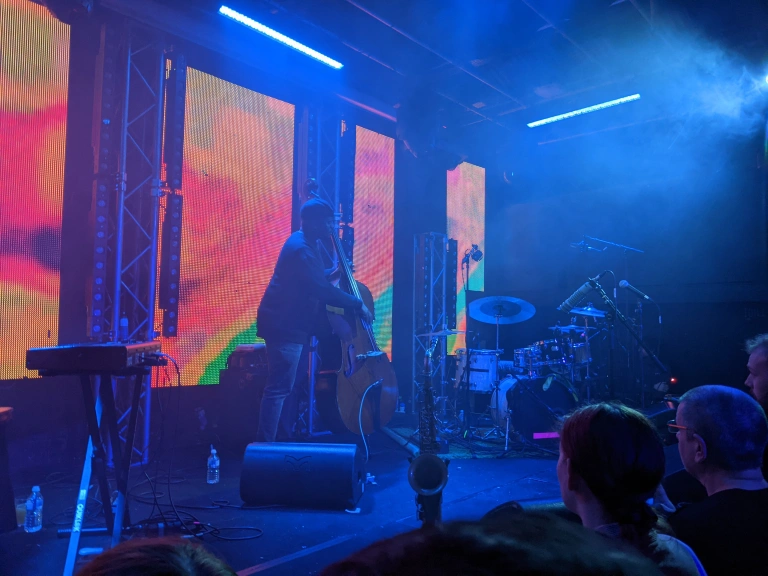
As a keyboardist myself, Joe inevitably got much of my attention for the night, but a more obvious performer to venerate was the woman on the ticket: Nubya Garcia, one of the headline artists amongst the much talked-about vanguard of contemporary British jazz. With a Medusa-like splay of dreadlocks and a wide stance, she was an admirably powerful figure on centre stage, wielding a tenor saxophone – alto’s musclier, more serious big brother. Ever since her debut EP Nubya’s 5ive was released in 2017, it seems like the general excitement around her ability to inspire a generation of new, young jazz fans has only grown and grown. Even the supporting players in that EP – Moses Boyd and Femi Coleoso on drums, Theon Cross on tuba – have also become major players in the new genre, bringing their own extensive range of bands and solo projects. Start researching and it’s easy to get lost in the proliferation of new, British (but, let’s be honest, mostly London) jazz, and as a young jazz player myself, it’s thrilling to watch. On walking into Gorilla, however, we were reminded that for all the growing momentum of UK jazz, it’s still far from the mainstream. Gorilla can only handle up to 700 jazzheads and the flickering LEDs behind the band hardly screamed high-budget. UK jazz is still jazz after all, with all its challenging harmony and abstract improvisation, and Garcia’s particular brand is hardly aimed at converting Ed Sheeran fans. Instead, her music digs into long and often noisy solos powered by splashy, busy drumming and colorful injections of dissonant harmony. Heads often only have slightly less improvisation than the solos themselves and hooks, while undoubtedly present, are hardly abundant.
With an audience of fans that get it (unlike Garcia’s recent televised performances at the BBC Proms or with Jools Holland), Garcia rightly had no hesitation in fully exploring every tune with epic solos and fluid song structure. Absorbing opener Source was a perfect example: the 12-minute studio version may be a bit much for some, but on the night it became a 20-minute jazz odyssey. Thankfully, it was difficult to get tired of the sticky, heavy dub reggae groove it its centre, underlined by a Daniel Casimir’s bubbly basslines and Tom Jones’ snappy sidestick. All four performers had plenty of time to make their introductions. Armon-Jones’ solo was captivating, segueing from a brief section of precise samba to a dense cacophony of glissandos and cluster chords. Daniel Casimir’s double bass solo was both the most succinct and successful solo of the bunch, adding more character and groove into his plucking than I thought was possible. A final, stupendous riff was greeted by a stunned applause, with Garcia noticeably reluctant to take back the lead.
As you can imagine, time went quickly and the band only had time to fit in a streamlined selection of six songs to play for the whole night. Garcia delivered some light-hearted and fun chat in between each tune. She had a tendency to get lost on a tangent about the origin of a song or the experience of playing her first tour post-lockdown, but even so it was lovely to see the obvious joy that performing her music to a crowd brings. “I’m in a good place right now,” she earnestly told the crowd at one point, to which we all cheered. If Queen Nubya was happy, then so were we.
The Message Continues followed a thought-provoking chat about Garcia passing on the ‘message’ of her heritage, which she encouraged us all to do too. The sparkling groove – one of Garcia’s most immediate and memorable – nods to her Guyanese and Trinidadian roots with a cumbia-informed bass riff and lightly shuffling drum work. Afterwards, Pace delivered a whole different world for the musicians to play in: a frenzied and overwhelming solo section was intended to mimic the stresses of constant touring and socialising with no rest. The eventual mayhem was made all the more impactful by what preceded it – a total bass solo from Casimir, for which the others left the stage completely. He was more than worthy of owning the stage for a few breathless minutes, each melody more beautifully adventurous than the last. I don’t think any of us wanted it to stop.
Another moment of surprising solace came with Stand With Each Other, a sparse combination of solo saxophone and tasteful afrobeat drumming. Here, Garcia’s outstanding tone was on full display; breathy, soulful and immaculately controlled. The saxophone really did seem to morph into a fifth limb – no longer merely an instrument, but a second voice through which to speak volumes more than words ever could. There was a spine-tingling sense of awe in the room as Garcia effortlessly faded out a long final note into silence.
Daniel Casimir’s solo at the start of Pace was one of the highlights
For all Garcia’s technical brilliance, it would be going too far to say her performance was flawless. Even Emma – an even stronger supporter of UK jazz than I am – admitted that her solos could get formulaic. Gradually building chromatically to ever higher, ever louder long notes seemed to be Garcia’s go-to game plan and, unlike Armon-Jones or Jones, there were few times we were wowed by her technical dexterity, even if her tone and command of her instrument is immense. A brief sortie into the squeaky and impressive-sounding altissimo range of her instrument during Pace was only partially successful, and certainly the more foghorn-like lower end of her tenor range had more impact during the big moments.
That said, Garcia doesn’t have to be John Coltrane to be an exciting artist, and seeing her and her friends create art in front of our eyes was a thrill unlike any of the over-rehearsed rock and pop concerts I’ve attended recently. As with most jazz performances, Garcia and her band of outstanding musicians were intent on creating something unique and impossible to replicate. Even Garcia’s chats were free-flowing and improvised, and the atmosphere in the room benefitted as a result. The venues and audience may remain relatively small thanks to the inaccessibility of her boundary-pushing style to the average listener, but Garcia deserves praise to sticking to what she loves. In an industry of Tiktok-pandering overnight millionaires and the same old chart-storming pop idols, a night at Gorilla was a pleasant reminder that this corner of fast-moving jazz well outside the mainstream isn’t going anywhere.
In a belated end to his UK tour, Oscar Jerome had enough strong material and bewildering virtuosity to compete with the very best of his UK jazz peers. It’s unfortunate he was let down by a patchy setlist, limiting instrumentation and questionable sound design.
For a moment I questioned whether I’d ever actually see Oscar Jerome in Leeds as we suddenly found ourselves at the front of a lengthy queue outside Belgrave Music Hall & Canteen. It wasn’t the first time; this gig in particular has been toyed with by the pandemic. It was postponed twice from its now quaintly ambitious original date in October 2020 and a third attempt a year later tragically coincided with a city-wide venue boycott amidst a completely seperate, equally uncontrollable epidemic of syringe spikings in nightclubs across the country.
It was only once we had been let in to the chic yet understated Belgrave Music Hall that reality set in for me and my friends Emma and Fionn. Despite arriving at a leisurely 8pm, we really had benefitted from a quirk in the queuing system, and sauntered up to a gloriously quiet and queueless bar like royalty before taking our pick of standing spot in front of the stage (in the middle, right at the front, of course). At one point Oscar himself even walked across the near-empty audience space (just a few feet away from us!), prompting palpatations. Shadowy in a trench coat and with his two emmaculate mirrored locks of hair, we had to check with each other our anticipation for the gig hadn’t led to hallucination. No, Emma’s astonished face confirmed, it hadn’t.
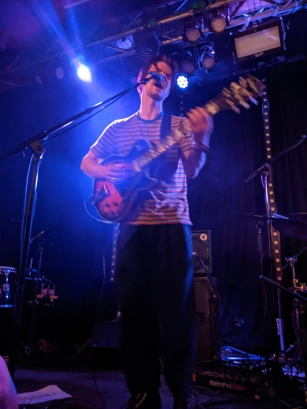
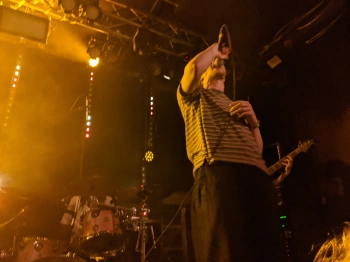
To add to our pleasant surprise, it wasn’t particularly long before the man himself was just a few metres in front of us, with his trench coat now cast aside to reveal a playful striped t-shirt behind a chunky Ibanez guitar. I’ve spent good chunk of the 18-month build up to the gig daydreaming about just how good inevitable opener Sun For Someone would sound and feel live. That purring bassline paired with Ayo Salawu’s nimble jazz-funk drumming could surely be nothing but electrifying in the flesh. Indeed it was, especially after meditative solo guitar musings of Searching for Aliens, which worked well as a calm before the blissful storm that followed.
In truth, I felt some niggling disappointment as Sun For Someone segued into the decidedly less exciting Coy Moon. The levels were all off. The kick drum and that bass line – however competently played by Tom Dreissler – swallowed up both Jerome’s guitar and vocals, leaving the melody often noticeably warped and the need for a bit of wishful thinking in order to hear one of Jerome’s finest tracks in its full glory. Whilst it was a recurring frustration on the night, on balance I think the main cause of the issues was in a lack of gigging experience from me, Emma and Fionn. In our front-of-the-queue giddiness we had inadvertently selected sonically the worst spot in the house, resulting in a face full of kick drum whilst Jerome’s dulcet tones were directed into the space behind us by speakers beside the stage. We might have been close enough to examine the glossy sheen on Jerome’s faintly dyed hair or assess whether he needs to trim his nose hairs (he doesn’t), but in return the sound would never quite feel professional quality throughout the night.
Somewhat consolingly, it wasn’t just us. I overheard talk about the haphazard levels immediately after the gig had finished, and even in the middle of the set there was evidence that there was issues for the performers too. Jerome requested his mic to be turned up during and after Sun For Someone; Dreissler needed time to fiddle with his bass between songs later on and a misbehaving kick drum mic was a repeated concern for both Jerome and Salawu, at one point completely taking the limelight from a blistering Richie Smart conga solo. Whilst I’ve learnt my lesson that the front row isn’t all it’s cracked up to be, I’m sure there’s more the sound engineers could have done to make it a less significant drawback on the night.
If the jazz fans around me were annoyed by the sound issues, they didn’t show it. The mood in the room was one of celebration, with Jerome humble enough to engage with every slightly over-eager heckler. There was the obligatory marriage proposals (“I will if you can get me an EU passport,” Oscar offered) and an accepted request for happy birthday from a very possibly intoxicated fan. One man even managed to buy Oscar a pint and hand it up to him between songs. The resulting chant of “chug! chug! chug!” crossed a line. “I don’t do shit like that anymore,” Oscar laughed before taking a grateful sip.
Just as it had done for Declan McKenna, Orla Gartland and Nubya Garcia, the pandemic has created an unusually big gap between the release of Jerome’s strong debut album Breathe Deep and a subsequent tour. As a result, Jerome caved into temptation to devote a good deal of the gig to unreleased songs from the upcoming follow-up album. It’s a risky, and in my opinion a little impatient, decision to take, and the four new songs aired on the night proved to be a mixed bag. Groovy and hooky Berlin 1 was the pick of the bunch, but Feet Down South also provided a great opportunity for an arresting bass solo from Dreissler. Sweet Isolation, on the other hand, was the flattest moment of the whole evening: a drab, meandering track that did little to inspire movement from the audience beyond a polite nod of the head. Devoting so much time to new songs also meant less time for tried-and-true hits. Give Back What U Stole From Me and Fkn Happy Days ‘N’ That – both highlights from Breathe Deep – were the two most obvious set list casualties.
As the sound levels improved, the highlights came with the songs that relied most on Jerome’s guitar virtuosity. Joy is You, a heartwarming ode to his newborn nephew, saw Jerome have the stage all to himself yet still provide ample soul and colour with some dextrous plucking. “As the past slips through the window / The joy is you” he sang with a smile, revealing some tender vulnerability that was well recieved by the crowd. By contrast, sophisticated and dynamic Gravitate was powered by Salawu’s brilliant, stumbling drum groove, but still saw Jerome improvising at his scintillating best amidst sumptuous melodic bass playing from Dreissler. An extended guitar solo was the only opportunity Jerome had to display his full jazz solo prowess, developing a seed of an idea into an all-consumming spectacle before kicking into one last chorus.
Jerome’s lack of saxophonist was not as fatal as Orla Gartland’s lack of keyboardist a few months ago, but certain songs did lose a good deal of their original detail as a result. 2 Sides and fan favourite Do You Really sounded simply incomplete without the great hooks that had been offered by saxophone and backing vocals on the originals. The three of us certainly tried our best to fill in the melodic gaps with our own voices on the latter, but there was only so much we could do. That said, sax or no sax, Do You Really remains a career highlight for Jerome, and a strong chorus was rapturously recieved by the crowd, prompting demands for an encore, with which the band happily obliged.
There was mock horror just before the start of the gig when we spied on the setlist taped to the stage floor that underwhelming recent single No Need was scheduled to be the final song of the night. We were in for shock: No Need was easily one of the best tracks of the night, taking us from rapid swing to hypnotic funk and back again and at last turning Belgrave Music Hall into a proper dancefloor. Salawu’s tastefully played real drums and Jerome’s rhythmic guitar made perfect replacements for the studio version’s drum machine and wishy-washy keys, and the transition from jazz to dance was executed with a thrill lost on the original song. To my huge relief, Jerome assured us that the concert was being recorded; I’m already desperate for a second listen.
As he bid farewell with No Need‘s slap bass and pounding kick drum, I was reminded that Jerome, for all his outstanding musical ability, is still in the early stages of a very promising career. With little more than an album’s worth of material at his disposal, conjuring up a five-star set was always an uphill battle, and dealing with less experienced sound engineers at the smaller venues may just be par for the course. Even so, after having had a brief chat with him after the gig, the post-gig high was very sweet indeed. The three of us practically skipped through central Leeds and back to the car, jubilantly singing Do You Really with a tote bag full of signed vinyls swinging from my shoulder. At last, there was no gig left to postpone, no songs left to wishfully daydream. The long wait had been worth it.
How exactly does the art of music-making change when it becomes a small part of a much larger video game or feature film? And what makes the soundtrack of Spider-Man: Into the Spider-Verse so remarkable? Alex Walden is on hand to reveal all.
One of the things that I love most about music is that it’s entirely subjective. There’s no genetic influence on what type of music you enjoy or what you look for in music; it’s completely down to just what your brain likes and that’s what makes it so unique. There’s complete freedom over what songs you like, what you like about music and what music you prefer to listen to while experiencing specific emotions. Take me for example: I can go from Kanye West to Nirvana straight to Jorja Smith like its nothing. Music’s ability to merge its way into any and every situation in life is one of the best things about it. So, what happens when entertainment corporations begin to realise this? The simple answer is that you get soundtracks, a collection of songs which feature sometimes extensive lists of artists from the same genre who are recruited to essentially convey to you how a project should sound. If done well, these soundtracks can become a great way to further indulge yourself into a corporation’s project. But what makes a soundtrack so good? By looking at some of my favourite examples I hope to give you an insight into exactly that.
DOOM and the ability to immerse To this day, the pair of unbranded plain grey headphones that my father bought for me as a Christmas gift years ago remain one of my essential items. The main reason for this is that they come with what was at the time a new feature known Active Noise Cancelling. Although I found this feature amazing when I first experienced it, it made me appreciate the idea of having music as background noise more. For example, as I’m typing this right now on my busted AirPods at about 60% volume in my silent room I can still hear the tapping sound of my fingers on my laptop, which is helping me from becoming completely focused on this Slum Village album, whilst helping me focus on what I’m writing. The addition of music is sometimes the crucial piece needed to allow a consumer to become immersed in entertainment and Mick Gordan’s DOOM soundtrack is a prime example of this.
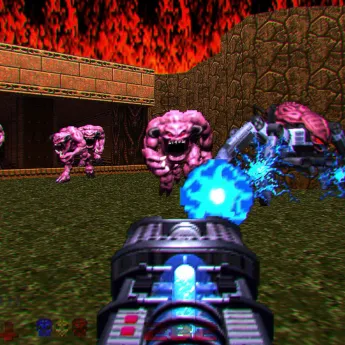
For those who don’t know, DOOM is a video game series which has been going since 1993. What started out as a simple arcade-style shooter has gradually progressed in recent years to become one of the most intense games ever released. You can only imagine how intense a game set on Mars with your primary objective to kill everything in sight in increasingly gruesome ways could be. Filled with fast paced action and highly detailed combat sequences, this game series has earned its place as one of my favourite game series to play. The game itself may be great, but the soundtrack is the driving force as to why this game is so special.
DOOM‘s original release dates back to 1993
As you tread through the game’s map you are given a subtle warning as a stream of white noise and bass tones hit you. In addition these sounds have been completely transformed by an extensive list of phasers, pedals, distortion boxes, reverb effects and many more. These short stretches of music are known as stems and are designed to give you an uneasy feeling of dread. It forces your brain to tell you “I don’t know what’s up ahead but whatever it is, it’s going to a be a lot”. As soon as the combat starts, the game’s techno-based sounds are completely thrown out the window, now replaced with no-nonsense metal. The addition of heavy metal music which accompanies a swarm of demons as they head directly towards you forces your body to produce a surge of adrenaline as you try fight your way through the horde.
Mick Gordon’s idea of combining metal with electronic sounding drums and heavily altered stems is not only genius, but also extremely difficult to pull off. Metal music has always been a violent badass and extremely niche category of music. It’s aggressive, fast paced and resembles everything about this new generation of music that your grandma hates. However, the fact that metal is so niche that can be its downfall sometimes. There are occasions metal fans don’t like when their genre is mixed in with more cliché genres such as techno. They feel as if their music is being watered down or that the people who make it are just doing it for money, not just the love of music. Yet Mick Gordon is able to use just the right amount of techno influence in extremely heavy basslines to add that extra kick that makes the music hit that bit more. I mean seriously – the drums and guitar riffs in this game are completely unmatched. It sounds something far beyond the capabilities of some video game composer from Australia.
Sometimes I need to pause DOOM… either I need to turn my volume down or I feel way out of my depth.
There have been times when I’ve had to pause the game while in the middle of a combat scene. This is always because of two reasons: either I need to turn my volume down because I can feel a headache coming on, or I just feel way out of my depth and need a minute to gather myself before I jump back into the game. That’s why I love DOOM so much. I’ve never played a game where I feel as if I’m being mentally dragged right out of my comfort zone, pushing myself to my limits as I try to comprehend everything around me while also trying to stay alive. I assure you that without a soundtrack, this game wouldn’t feel the same. (No seriously, I’ve actually played the whole game on mute while I watch a show in the background). But with Mick Gordon’s remarkable background music blasting through my ears, my mind constantly bounces back and forth between the thoughts of how amazing a song is and how I’m currently flirting with death in my game right now. It’s as if the game is able to control my brain, messing with me so that I’ll find it all the more challenging to complete.
Spider-Man: Into the Spider-Verse and the construction of fictional universes
It’s time I let you into my lives a little more now. I have to admit I’m practically in love with the Post Malone and Swae Lee song Sunflower. Ask anyone who knows me and they’ll tell you I have a borderline unhealthy addiction to this song. At the time of writing this, Sunflower is my most played song on Spotify since I created my account (that must say something considering that this I discovered this song 5 years after I first created my account). If I’m honest, I could easily write a whole dissertation level paper about how the movie, Spider-Man: Into the Spider-Verse, is a perfect movie but for now I’m going to attempt to restrain myself and try to only talk about why the soundtrack is able to help construct a fictional universe for the consumer.
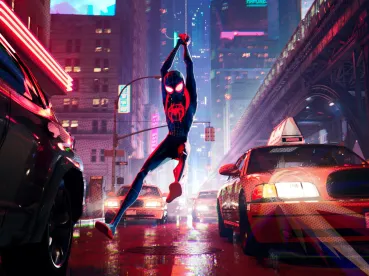
Spider-Man: Into the Spiderverse received widespread critical acclaim in 2018 for its creative storytelling and hit-filled soundtrack
Spider-Man Into the Spider-Verse is, in my opinion, the best spider-man film made to date. The story follows Black and Puerto-Rican teen Miles Morales as he begins his journey at the Brooklyn Visions Academy. It’s clear from the beginning that Miles isn’t a huge fan of the academy and feels pressured to live up to his father’s expectations. However, while hanging out with his Uncle Aaron, Miles’ entire world gets completely flipped upside down when he gets bitten by a radioactive spider. I’ll spare you my synopsis of this film, but seriously there’s practically and endless list as to why I love this movie so much. One of the key things I always notice is that like most teens in this day and age, Miles gets anxious and things can feel mentally out of his control very quickly. It’s through music that Miles is able to calm himself down, which I know is a very common practice for people who struggle with anxiety, so we naturally relate to him because we see he’s just a kid underneath the mask.
One of the best decisions Marvel made was constructing this specific movie soundtrack. We feel as if we’re being brought into Miles’ world. With tracks like What’s Up Danger and Start a Riot we get the textbook high energy songs that let our minds wander and draw up our own Spidey-themed scenarios in our heads, but with tracks such as Sunflower, Invincible and Scared of the Dark we’re brought into Miles’ personal life. Behind all the vigilante stunts, he’s really just a kid from Brooklyn. It’s through this that were able to build a connection with Miles and we feel as if we actually know him – after all, we know his music taste, his character traits, and his biggest secret.
It’s through the soundtrack that we’re about to build a connection with Miles. We see he’s just a kid underneath his mask.
One of the most common issues with movie soundtracks today is that, although companies tend to recruit artists who are in the mainstream scene at the time, it often sounds forced and cringey because let’s face it, the number one rule with any creative passion is that it shouldn’t be forced because everyone can tell when it’s not from the heart. I’ve even read up on cases where artists have been paid to name drop specific brands in their lyrics. People can tell if you have a genuine passion for something or if you’re just doing it for clout. But with Into the Spider-Verse’s soundtrack, Marvel managed to group together artists who fit quite well in the hip hop and pop rap categories, so for them this was just another song for them to write. In particular, you can hear how good the genuine chemistry is between Post and Swae throughout the song Sunflower. It’s probably why Post decided to take Swae Lee on tour with him after the songs release.
mid90s and cultural representation
If you would’ve told me when I was a kid that hip hop would become one of the most popular genres of music in the future, including the number one in America at one point, I would’ve thought that you were talking complete nonsense and I’d have fair reason to. Up until 2016, hip hop was seen as the outcast genre. It was viewed as the genre which your kids should avoid and hip hop artists were deemed to have no valid musical talent. One of my other favourite hobbies as a kid which also got a bad rep was skateboarding. I grew up in the era of skateboarding where the days of kids watching Tony Hawk blast off crazy huge ramps and go around pools were starting to fade as street skating grew in popularity. This obviously led to skateboarding being viewed as a reckless sport which some people even saw as a crime. The representations of these two interests of mine are why they used to be home to quite niche communities, which is the same reason they ended up getting represented so poorly in mainstream media, because the people who write about it often don’t know anything about it. Despite this, there is the odd moment where it’s done well and mid90s is a prime example of how it’s done perfectly.
Jonah Hill gave all the kids on set real iPods to listen to 90s hip hop on. As someone who skates, this is a major victory.
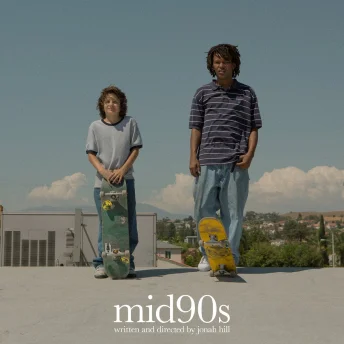
The story of mid90s is relatively simple. It follows 13-year-old Stevie (Sunny Suljic) as he navigates his way through summer accompanied by a troubling home life and a group of friends he meets at the local skate shop. What I like most about this film is that it accurately represents the skate community by showing all skaters are different; hell, some of the skaters in this film are in their teens while some are just kids. It’s not just some attempt at seeming edgy for a money grab. In fact, all the people who play skaters in mid90s were skating way before they were acting. You can find them on the Illegal Civ YouTube channel which is what makes this movie so comforting to watch you feel as if you’re just watching some kids skate. It doesn’t feel like you’re watching some scripted attempt at making skating seem rebellious and edgy.
mid90s marked Jonah Hill’s directorial debut in 2018
One of the best aspects of this film is that it features music from the time that the film is set. As a matter of fact, director Jonah Hill gave all of the kids on set iPods which were all filled with songs that he used to listen to growing up in the 90s. Many of the songs on these iPods were from artists such as Pixies, Wu Tang Clan and The Pharcyde who were also featured during the movie. Now, to the average viewer this would just be seen as a method to help add to a scene, but as someone who skates this is a major victory. I remember hearing 93 ’til Infinity by Souls of Mischief and Put It On by Big L and feeling surprised that a movie about skating was using songs that actual skaters listen to. My friends and I actually listen to some of these songs on the regular and I’m hearing it in this movie? It felt weird at first but then it felt great realising that the director, who had decided to bring quite a small sport to the big screen, had actually nailed the portrayal of skaters and had taken the steps necessary to do so. Not only that, but thanks to mid90s I was able to discover loads of new artists and songs. After watching the movie, one of the first things I did was find a Spotify playlist with all the songs featured in the movie. I was blessed with Spotfiy’s own official mid90s playlist which even included small anecdotes from Jonah Hill himself. It was through this playlist that I was able to discover golden era hip hop and how as well as good music, it doubled as an awesome soundtrack for skating. I remember trying to skate around my neighbourhood while listening artists such as Raekwon, Nirvana and, now one of my favourite groups of all time, A Tribe Called Quest. It was through times like this that I was able to explore skate culture which has become one of the best parts about my daily life. Of course, there were other instances as to why I had discovered skating, like the famous Tony Hawk games, but I feel as if it weren’t for mid90s I wouldn’t have been able to link together this fun hobby with one of my favourite things in the world, music, which has led to skating and skate culture becoming a huge part of me.
So there you have it: three examples of how a soundtrack can become a valuable feature of any project. I feel like often soundtracks can get overlooked by some who just view it as an accessory and I will admit that sometimes it can fit that description if poorly constructed, yet I hope that these three examples of iconic soundtracks have helped you realise that soundtracks can often be underrated. Maybe it’s just my habit of having a particular interest the little things and small details talking for me, who knows? What I do know though, is that next time you go watch a movie or play a video game or even go somewhere with your friends or family and you feel some extreme emotion whether it be joy, sadness, anger, or any other variation of mood, pay attention to what music is playing in the background or the songs that you play that day. You might make some amazing memories which you can then attach to a specific song. That is what makes soundtracks so amazing.
The much-hyped band crowned a breakout year with a bangers-only 45 minute blitz in Leeds, packed with mammoth riffs and thunderous bass lines. Even the band’s photographer couldn’t resist the pull of a vintage mosh pit.
Twilight on a moody November evening by the canal in Leeds, and the leaking locks are hissing harshly behind a gloomy row of trees. At 8 p.m. it’s still just about bright enough to make out the passing clouds, oddly glowing with light pollution against navy skies. I’ve only just arrived, but I already feel exhausted – with the murky recent weather, a cold going round and a certain election result, I can’t have been the only one approaching Project House feeling weighed down by November blues. I walked towards the reassuring thud of live music – the muffled sounds of what turned out to be a rather dreadful support slot from Truthpaste – hopeful the music might provide some catharsis.
As it happened, few bands do reckless, enthralling catharsis quite like Fat Dog. Like Black Country, New Road and Black Midi, they were borne out of the fertile left-field music scene centred on the legendary Windmill venue in Brixton, making a name for themselves in recent years solely through notoriously wild live shows. Fat Dog’s unique sound is charged with an impulsive energy that makes it easy for audiences to be swept away by it all even without prior exposure. Remarkably, one scant album into their career, Fat Dog have already carved out a distinct stylistic niche – aggressive industrial dance music with thunderous unisons riffs, scuzzy saxophone and yelped, barely coherent vocals about impending doom. Think somewhere between Madness and Daft Punk, but with more lyrical references to slug invasions. It’s unlike anything I’ve heard before.
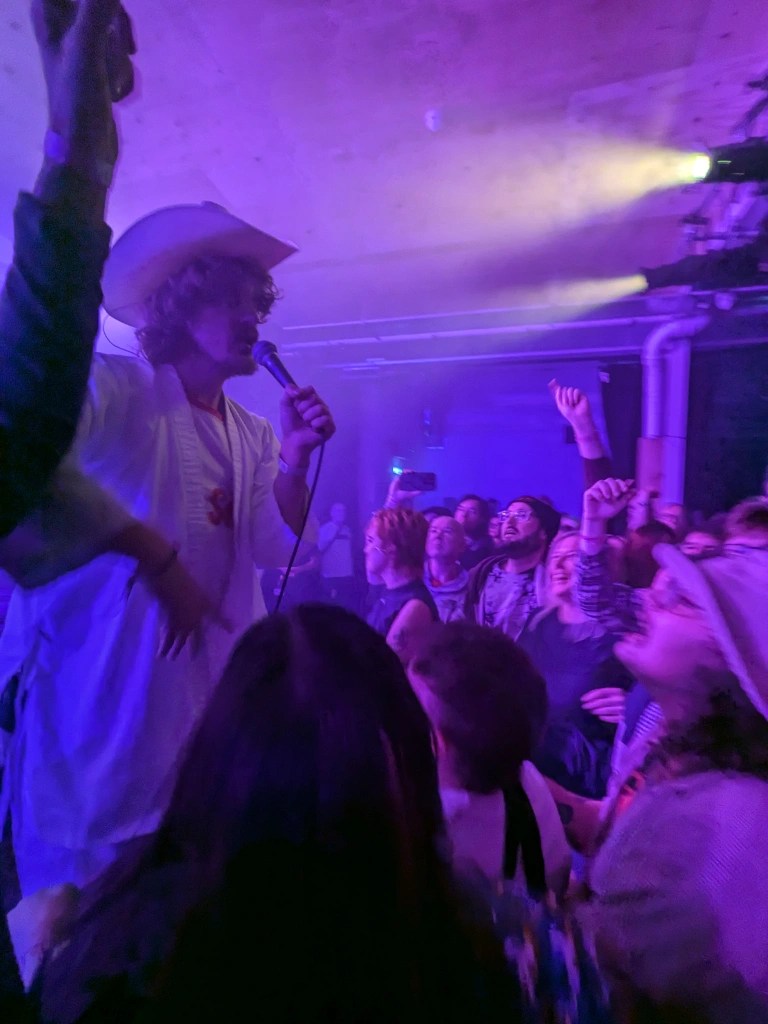
You could forgive Fat Dog for being exhausted themselves – they’ve essentially been on tour for their entire career so far, including a marathon four performances on various small stages at this year’s Glastonbury. Emerging onto stage to a volley of drums and a tremble of deep synth bass, frontman Joe Love was a wonderfully enigmatic figure, his eyes barely open beneath a canopy of curly locks and a white Stetson. Vocally, he made no sense either, producing a manic yelp of “It’s Fat Dog baby!” at the start of the concert, sounding more menacingly deranged than comical.
Such is the unique appeal of Fat Dog, a band who on paper sound jokey – drummer Johnny ‘Doghead’ Hutch has a penchant for performing in a German shepherd mask, sadly not donned in Leeds – but in reality sound like credible harbingers of the apocalypse. It didn’t take long for the audience to start colliding with each other to the sounds of Vigilante, an album opener which brilliantly pairs a mammoth hook with a haunting, vaguely Eastern European folk melody. Gone were the intricate details of the studio recording – most notably a melodramatic spoken word passage, and a gigantic-sounding string orchestra carrying the hook – but in Leeds an additional percussionist was let loose on an arsenal of bongos and cymbals, more than plugging the gap. The result was an intoxicatingly heavy three minutes that had an instant, drug-like effect on the audience, who duly threw their arms – and beers – up in the air.
Joe Love’s performance was intimate for those in the front row.
It was enthralling – but then again I’m bound to say that, since Love spent a majority of this brief gig right next to me, close enough I could have nicked his hat. He leaned against the barriers for song after song, singing directly to his devotees like a young Nick Cave, only with less heartfelt hand-holding and more woofing into the microphone. It was a thrill to be in the mix of bodies with their arms reaching up towards him, but I doubt the people a little further back from me – spending most of the gig looking at a largely empty stage – would have agreed.
From my fortunate vantage point amidst the mosh, the only possible downside of Fat Dog’s set was that each song was almost too exhaustingly compelling. Seven-minute opus King of the Slugs was a marathon of industrial beats, particularly in its propulsive second half where the tempo was ruthlessly dialled up a notch. Wither similarly took off like a rocket, Jacqui Wheeler’s restless bass riff and Love’s oddball intonations of “You better wither, baby, before you die” whipping up a frenzy in the crowd. The bedlam was so irresistible that, in one exquisite moment of rock ‘n’ roll, even the hired photographer camped out beside the stage in front of me felt compelled to down tools and leap into the crowd, practically landing on top of me. A few seconds later I watched her drift off to the dim recesses at the back of the venue as Morgan Wallace’s saxophone squealed like a wounded pig.
Even I Am the King, the unconvincing ballad lodged in the middle of the band’s debut album, sounded gripping in Leeds, the shimmering backing of strings given new urgency by Hutch’s rapid hit-hats ticking away like a time bomb. “I am the king… and it means nothing at all,” Love repeated again and again with rising desperation, the swirl of synths rising around him like floodwaters. Yes, Love has penned plenty of silly lyrics (his first words in his debut album are “Granny’s tights on my head”), but this was a moment of genuine artistry and the evening’s only opportunity for pause and reflection.
It all came to ahead with an electrifying rendition Running, a stupendous single and one of the very best songs from any band this year. It’s a masterclass in tension and release, evident in Leeds when it triggered not one but three mosh circles (where fans clear an area of the floor then rush into the space when the chorus hits). The lengthy bridge in particular was excruciatingly tense, and by the time the eventual payoff came – a panoply of winning hooks, all neatly foreshadowed earlier in the song – bodies were circulating in the crowd as if swept up in a fast-moving lazy river.
An encore of noughties rave classic Satisfaction – a perfect riff for Wallace to attack on her saxophone – wrapped things up before the clocks struck 10 p.m.. Too early to call it a night perhaps, but I’m not sure if I had the physical fitness for much more, and the revellers around me looked like they’d been worked to exhaustion too. In the end, the crowd simply barked in unison instead of asking for one more song – if Fat Dog had indeed imbued their strange music with some sort of magic potion, it had worked a charm.
The most interesting listening right now is happening between categories. Indie records are borrowing the patience of ambient music, jazz players are leaning into club rhythms, and electronic producers are making tracks that feel more handmade than programmed. That middle ground is where a lot of the best music lives.
Indie music is getting quieter and stranger
The strongest indie songs at the moment are not always the biggest ones. Many of them work through restraint: dry drums, close vocals, guitars that sound like they were recorded in a room rather than polished into glass. That intimacy gives the songs character.
Jazz keeps moving outward
Modern jazz continues to thrive when it treats tradition as a starting point rather than a museum. Groove-led playing, electronic textures and shorter song forms can all sit comfortably beside improvisation. The result is music that feels serious without becoming sealed off from everyday listening.
Electronic music is embracing warmth
There is still plenty of maximal electronic music around, but the warmer end of the spectrum feels especially rewarding. Dusty percussion, imperfect synth tones and patient arrangements are giving producers more emotional range than the cleanest possible mix ever could.
For Music Boats, that combination feels like the right direction: thoughtful listening without losing energy, and genre coverage that follows the sound rather than the label.
The first warm nights of summer call for music that does not rush the moment. The best tracks for this part of the year tend to balance lift with ease: enough rhythm to make the evening move, enough softness to let the light fade slowly.
1. The opener with a soft pulse
Start with something that moves gently rather than announcing itself. A light drum pattern, warm keys and a vocal that leaves space can set the whole tone for the night.
2. The indie-pop reset
A bright guitar line still does a lot of work when the weather turns. The trick is avoiding songs that feel too polished. Slight looseness makes the track feel lived in.
3. The jazz-leaning groove
Late evenings suit rhythm sections that breathe. A bass line with swing and a drummer who leaves room around the snare can make a track feel relaxed without becoming passive.
4. The electronic slow-burn
Not every summer track needs a huge drop. Sometimes a patient synth pattern and a steady kick create more atmosphere than a chorus built for instant release.
5. The closer
End with something reflective. The best final track should feel like walking home after the noise has settled: still rhythmic, still alive, but already turning into memory.
The real ranking is less important than the shape. A good warm-night playlist should move from open-window brightness to late-hour calm without losing its sense of pulse.
Music culture moves quickly, but listening does not have to. The constant flow of new tracks can make everything feel disposable, even when the songs themselves are carefully made. Patient listening is a quiet refusal of that pressure. It means giving a record enough time to become familiar before asking whether it matters.
Discovery is not the same as attention
Streaming has made discovery easy. Attention remains difficult. Finding a song takes seconds; living with it takes longer. The difference matters because some music is designed for instant recognition, while other music works by slowly changing the listener’s sense of mood, rhythm or memory.
Patient listening does not require abandoning playlists. It simply asks for a different habit: return to the same album over a week, listen without skipping the middle tracks, notice how sequencing changes the meaning of individual songs. These small choices make music feel less like background and more like a conversation.
The slow listen is coming back
There are signs that listeners still want depth. Vinyl culture, album-listening clubs, long-form music podcasts and detailed fan essays all point to the same desire: people want to spend time with music, not just pass through it. The format may change, but the need is old.
Patient listening is not a purist stance. It is a practical one. Some songs give everything immediately. Others need room. The pleasure is learning which is which.
Every few years someone declares guitar bands finished, and every few years a loud room proves otherwise. The format keeps surviving because it does something very direct: it turns physical movement into sound. A drummer lifts the room, a bass player locks the centre, and guitars create pressure, colour and release in a way that still feels immediate.
The appeal is physical
Rock gigs work because the audience can read the performance almost instantly. You can see where the sound is coming from. You can feel when the band is pushing ahead of itself or pulling back into control. That visible effort matters. It gives the songs a body.
Modern rock bands do not need to pretend nothing has changed. The most interesting ones borrow from pop structure, electronic texture and post-punk repetition without losing the core appeal of a band on a stage. The point is not purity. The point is impact.
Small rooms keep the format honest
In a small venue, a guitar band cannot rely on distance. The sound either connects or it does not. Riffs need weight, choruses need shape, and slower songs need enough tension to stop the room drifting. When it works, the result is still one of the most reliable live music experiences available.
The reason guitar bands still make sense is not nostalgia. It is utility. They remain one of the simplest ways to convert shared attention into shared energy, and that still counts for a lot.